Durians, beads and a phoenix: the stories behind Singapore's special helmets
Alex Albon brought Southeast Asia's most divisive fruit to Marina Bay, while McLaren's drivers turned to a century-old Peranakan craft. Here is the heritage behind the designs.
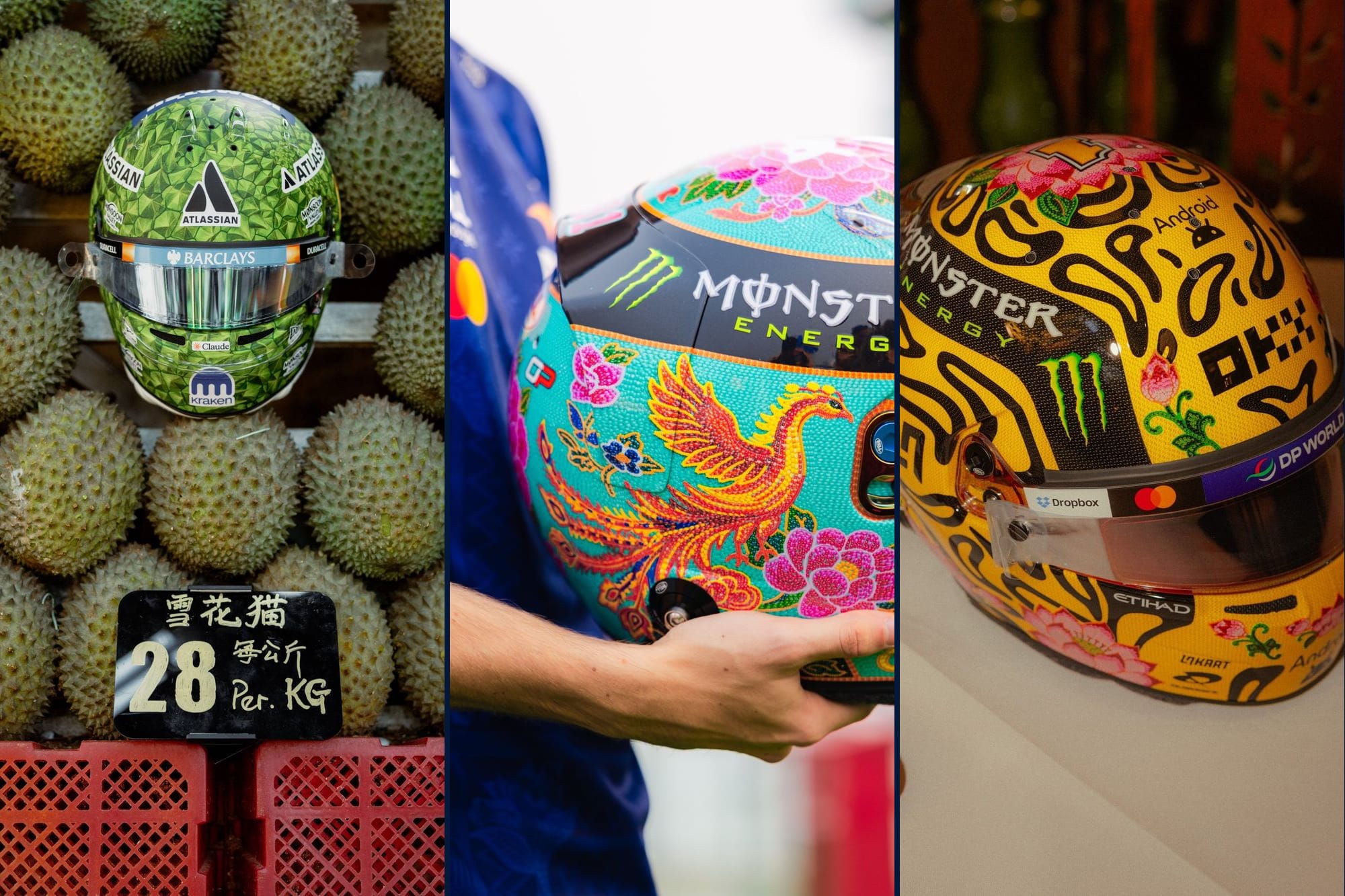
Special helmets have become part of the Singapore Grand Prix. This year, three of them tell a story about the region itself: one about its most famous fruit, two about a craft that was once close to dying out.
Alex Albon: the king of fruits
For Thai driver Alex Albon, Singapore is the closest race to home on the calendar. So he picked the most Southeast Asian thing he could think of: the durian.
The helmet recreates the fruit’s green, spiky skin, with price tags that nod to local fruit markets.
Why the durian
Across Southeast Asia, the durian is known as the “king of fruits”. It is big, heavy and covered in thorns, with soft, creamy flesh inside. People either love it or cannot stand to be in the same room.
That is because of the smell. It is so strong that durians have been banned from Singapore’s trains since 1988. The red “No Durians” sign, showing the fruit with a line through it, has become one of the city’s best-known pieces of signage.
Fans still queue at roadside stalls, where durians are piled high and sold by the kilo. And the fruit is even part of the skyline. The Esplanade, the theatre complex on Marina Bay right beside the circuit, is nicknamed “The Durian” because its domes look like the fruit.
The reveal
Albon leaned into all of it. His first photo shows him in the helmet, holding up the “No Durians” sign, with the caption “Keeping the visor closed this weekend”. The next has the helmet sitting on a pile of durians at a fruit stall, behind a handwritten price tag reading “28 per KG”.
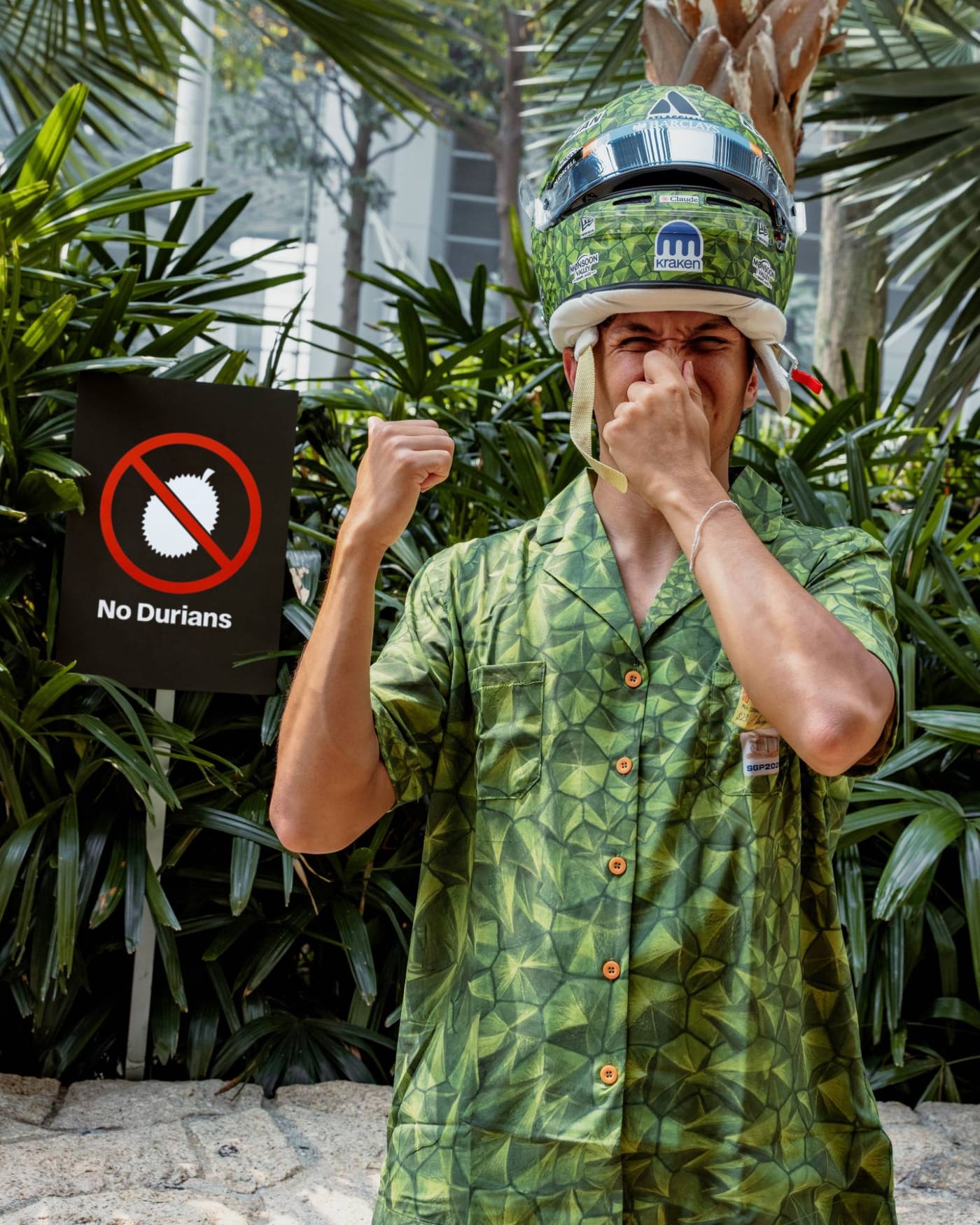
Albon’s reveal, next to the sign every Singaporean knows. Photo: @alex_albon on Instagram
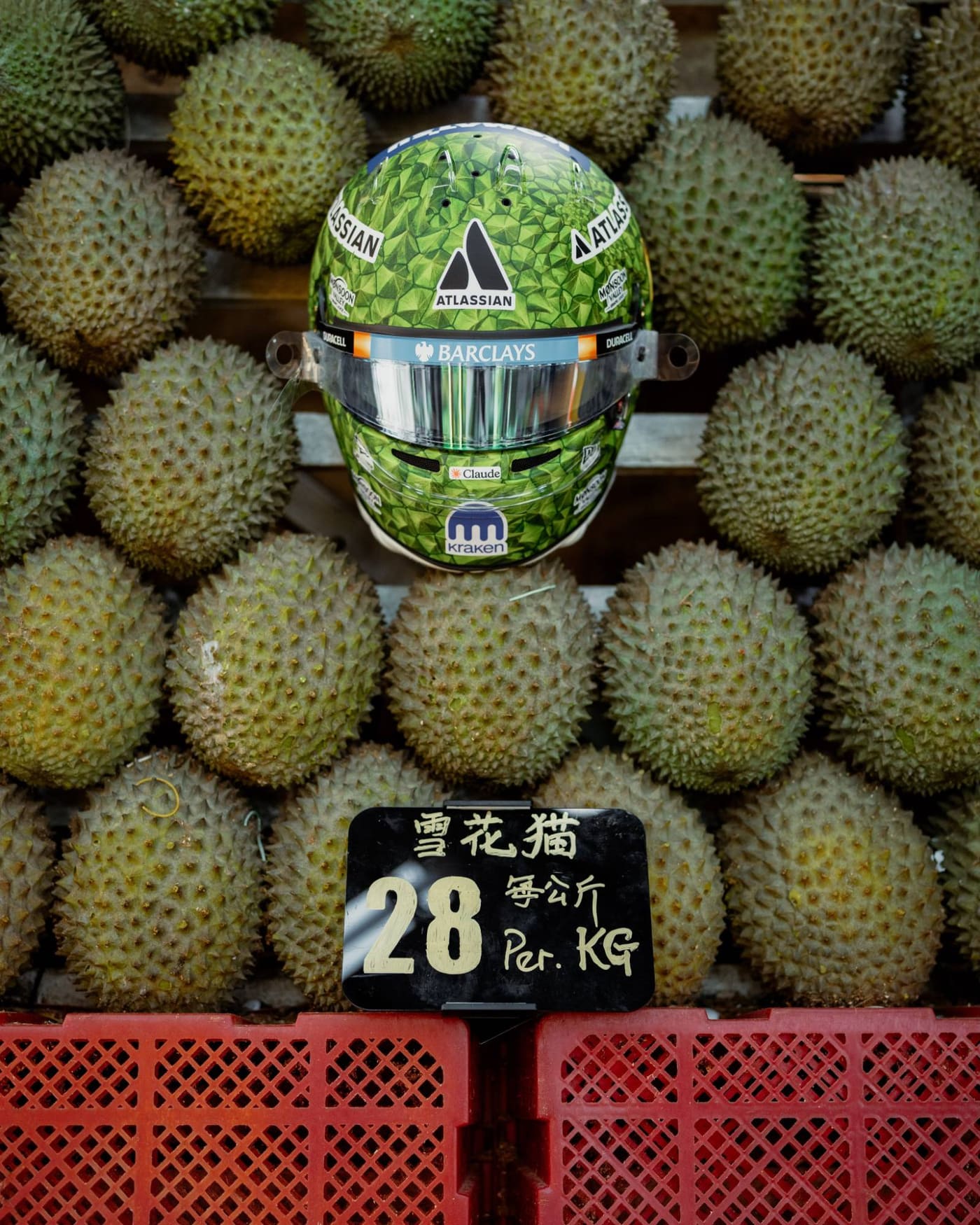
Right at home: the helmet on a durian stall, priced at 28 per kilo. Photo: @alex_albon on Instagram
The Peranakan story
Both McLaren drivers went back much further for their designs, to Peranakan beadwork. Both helmets are part of the team’s partnership with Android.
Who the Peranakans are
The Chinese Peranakans trace their roots to Chinese traders who settled in Melaka from the 14th century and married local women of Malay, Javanese or Balinese heritage. Their communities grew in Melaka, Penang and Singapore, with a culture that mixes Chinese, Malay and later European influences. The men are known as Babas, and the women as Nyonyas.
The beadwork
Nyonya beadwork uses tiny glass seed beads, just 1mm to 2mm across, sewn one by one onto fabric. The best-known pieces are kasut manek, beaded slippers worn with the sarong kebaya, the traditional Nyonya outfit.
The skill was passed down from grandmothers and mothers to daughters. Brides would bead slippers and belts for their grooms, and a single pair of slippers could take months to finish.
Every motif carries a meaning. In Peranakan beadwork, the phoenix stands for virtue and grace, the peony for prosperity and honour, and the butterfly for love and happiness. At weddings, a pair of phoenixes represents the couple.
The craft nearly disappeared. Beads became hard to find after the Second World War, and factory-made shoes replaced handmade ones. It was only in the mid-1990s that a revival began in Singapore, as a new generation started learning from the last of the older beaders.
Oscar Piastri: the phoenix
Piastri’s helmet is the real thing. It features beadwork made by hand in Singapore: around 350,000 glass beads, which took two months to finish.
The turquoise base is covered in fine bead texture, with a large red, orange and yellow phoenix on the side, surrounded by flowers. Blue, in Peranakan colour symbolism, stands for joy and happiness.
It was presented to him at the Peranakan Museum by Angeline Kong, one of the beaders who helped keep the craft alive. She started learning in 1997, inspired by the beaded shoes of her grandmother’s eldest sister, and has taught others ever since.
“Nothing is just decoration. Everything carries meaning,” she said of the work.
Piastri was clearly a fan. “I’ve done a few special helmets in Singapore before, but this one is definitely my favourite,” he said.
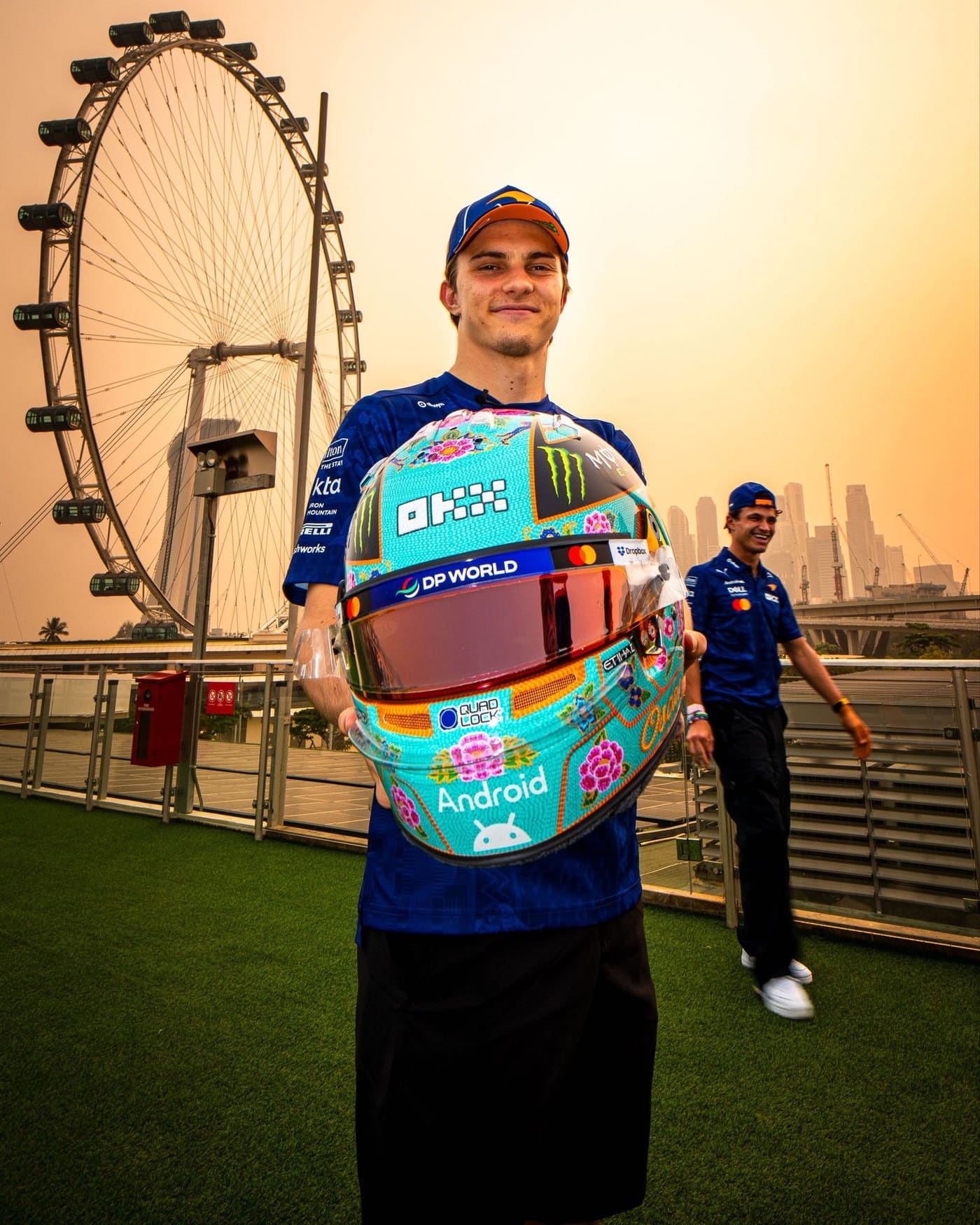
Piastri with his helmet by the Singapore Flyer, a short walk from the circuit. Photo: @mclarenf1 on Instagram
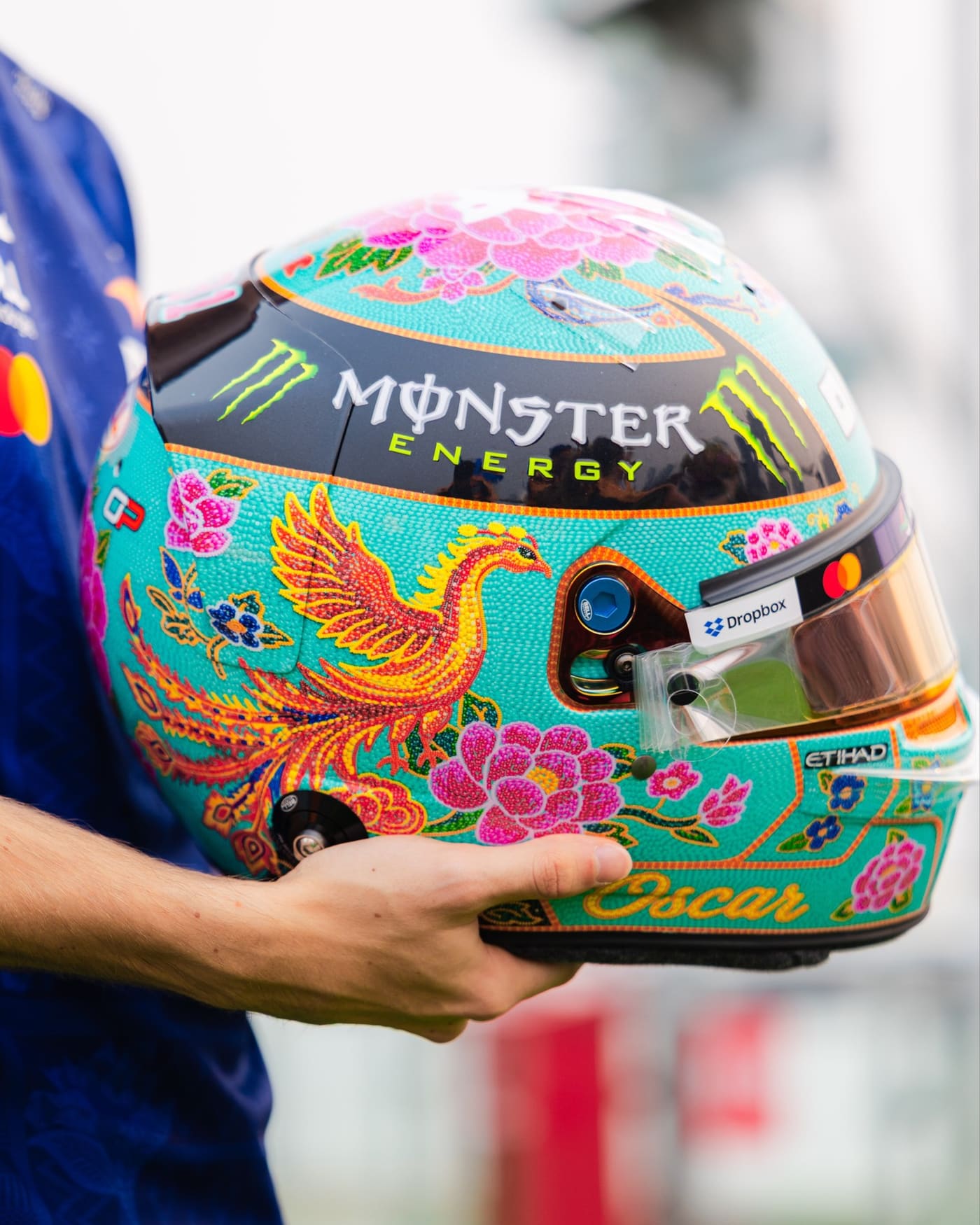
The phoenix up close. Every dot of colour is a single glass bead. Photo: @mclarenf1 on Instagram
Lando Norris: the lotus
Lando Norris kept his trademark look and gave it a Peranakan twist. His yellow helmet keeps the black “blobs” from his usual design, with pink lotus flowers on top.
The lotus is one of the oldest symbols in Asian art. Because it grows out of muddy water and still blooms clean, it stands for purity.
In his words, the helmet is “singapore style meets the blobs”, inspired by Peranakan beadwork and designed by local artists.
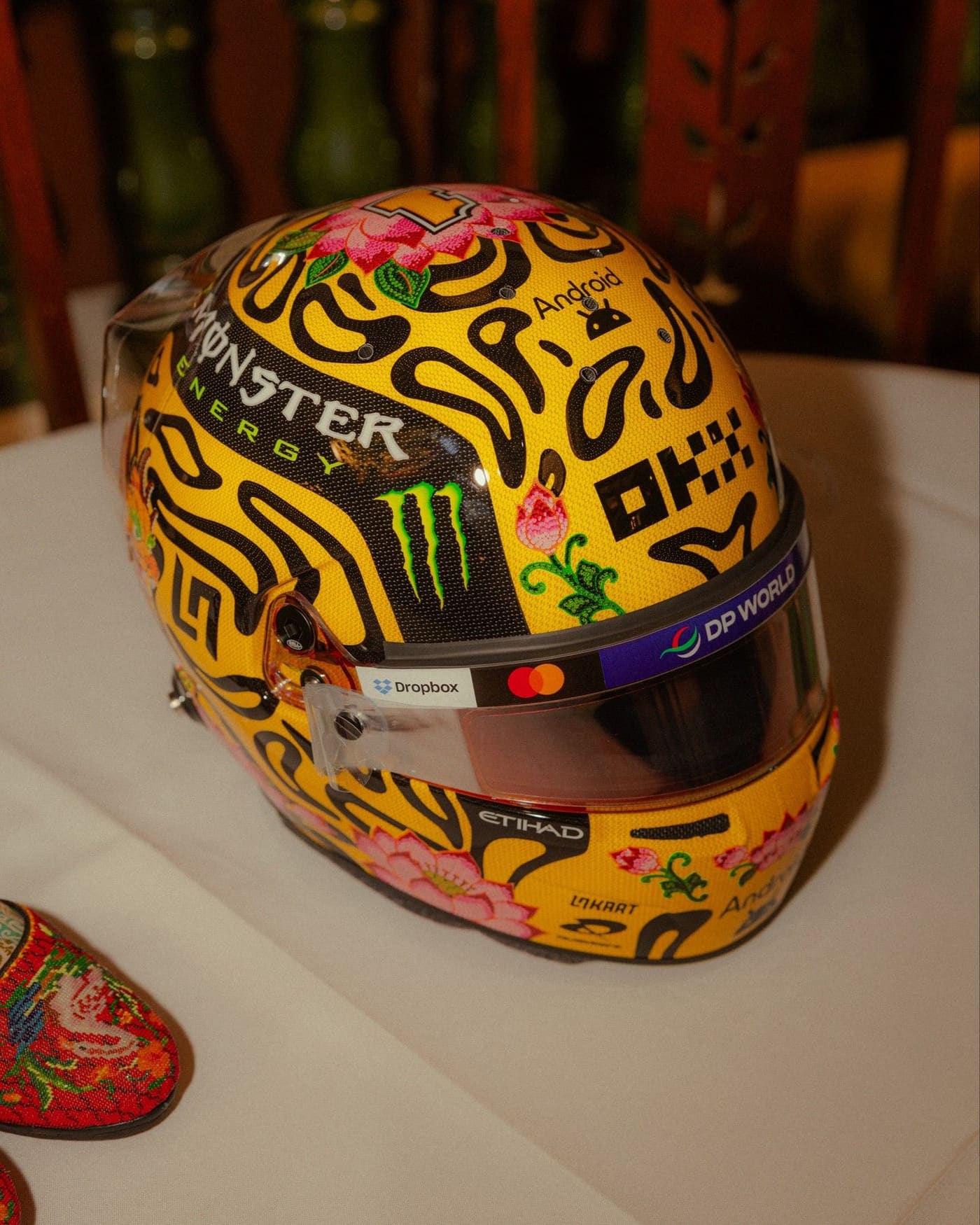
Norris’s helmet beside a beaded slipper, or kasut manek, the craft that inspired it. Photo: @mclarenf1 on Instagram
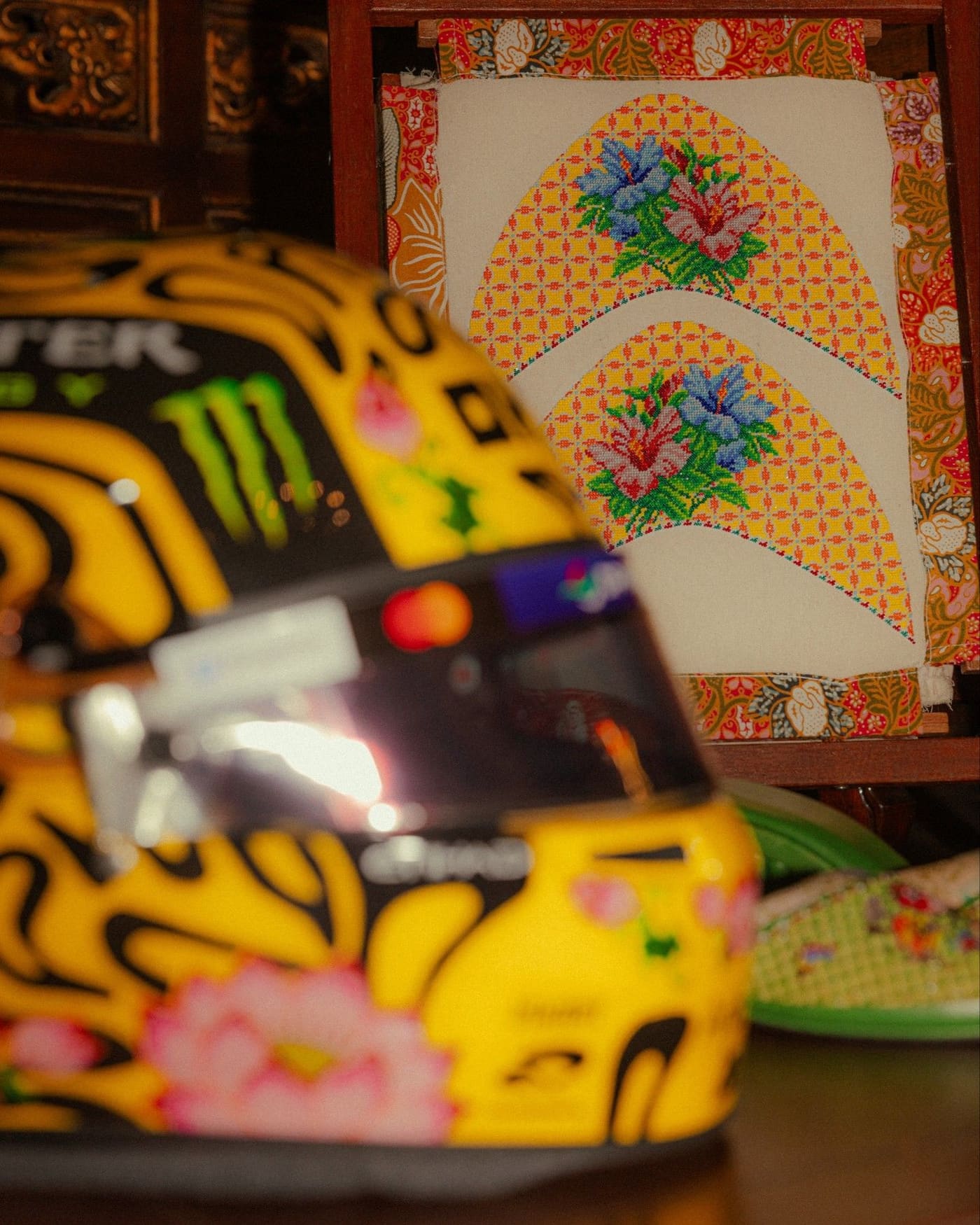
Behind the helmet, beaded slipper uppers on a wooden frame, made the way Nyonyas have done it for generations. Photo: @mclarenf1 on Instagram
A craft that was nearly lost after the war is now on two of the most-watched helmets in Formula 1. And somewhere in the paddock, a durian is doing laps of Marina Bay.