MotoGP 2026 vs 2027: what changes with the new 850cc bikes, and how much slower will they be?
MotoGP's 2027 bikes get smaller engines, less aero, no ride-height devices and Pirelli tyres. Every change side by side, plus what the first tests say about lap times and top speed.
MotoGP is about to change more than it has in years. From 2027, the bikes get an 850cc engine in place of today’s 1000cc, lose their ride-height devices and some of their aero, and switch from Michelin to Pirelli tyres.
The aim is to slow them down where it matters most. The 1000cc bikes hit 368.6 km/h (229 mph) at Mugello this year, and MotoGP says the smaller engines “will decrease top speeds, making the sport safer”. It’s promising bikes that are “safer, more sustainable and even more spectacular”.
The surprise so far is that the new bikes may not be much slower over a lap.
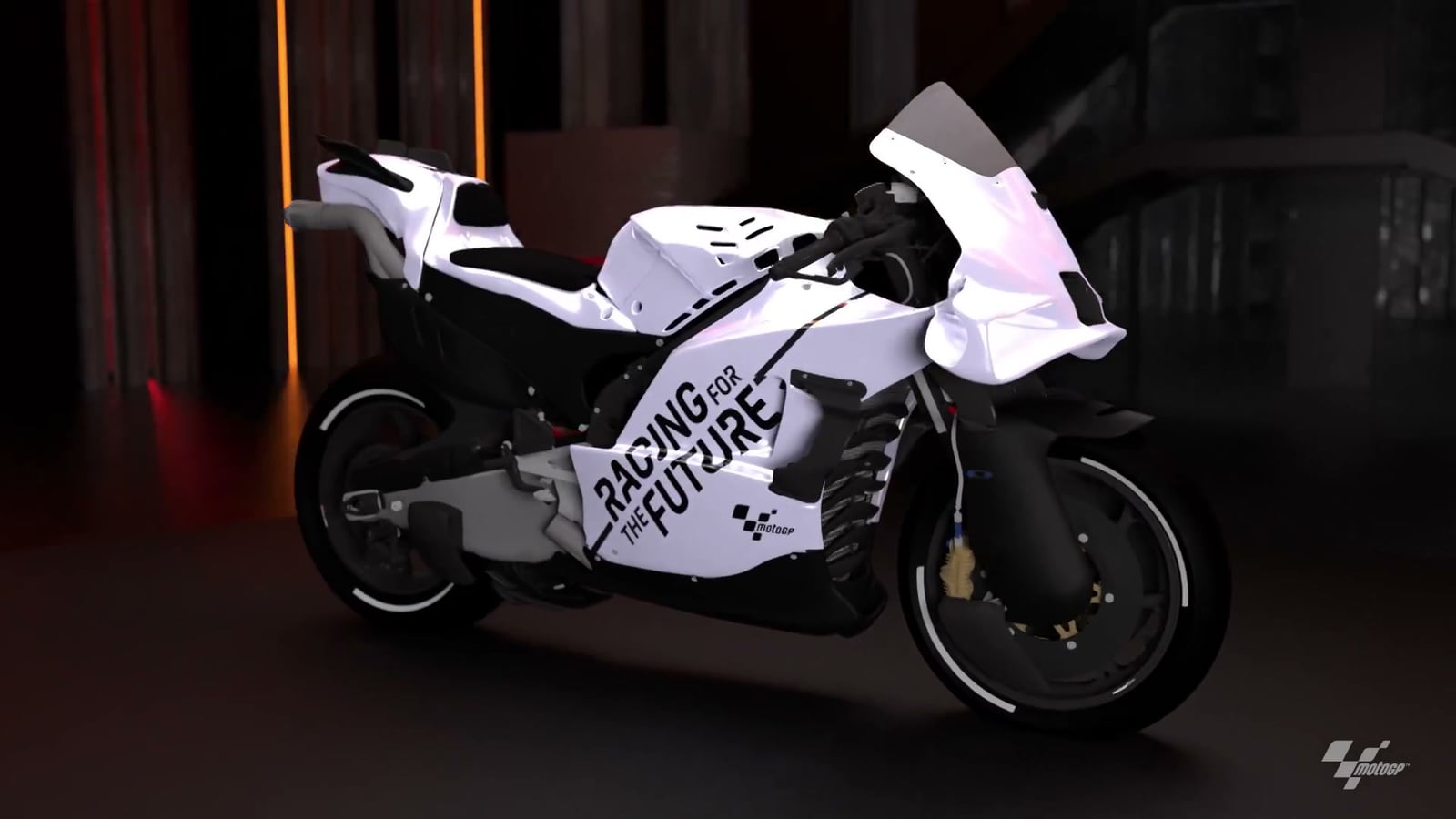
The 2027 rules on a concept bike, from MotoGP’s explainer video. Image: MotoGP
2026 vs 2027 at a glance
| 2026 | 2027 | |
|---|---|---|
| Engine | 1000cc | 850cc |
| Maximum bore | 81 mm | 75 mm |
| Power | 280 to 300 hp | About 50 hp less |
| Minimum bike weight | 157 kg | 153 kg |
| Ride-height devices | Rear devices allowed | All banned, including holeshot devices |
| Front fairing width | 600 mm | 550 mm |
| Rear end height | 1250 mm | 1150 mm |
| Fuel tank (Grand Prix) | 22 litres | 20 litres |
| Fuel tank (Sprint) | 12 litres | 11 litres |
| Sustainable fuel | At least 40% | 100% |
| Engines per rider | 7 | 6 on a 20-race calendar, 7 on 21 or 22 races |
| Tyres | Michelin | Pirelli, on a deal to 2031 |
| GPS data | Each team’s own | Every rider’s data shared with all teams after each session |
Rule details from MotoGP and Crash.net. Power figures are estimates, because manufacturers don’t publish them.
What each change is for
The smaller engine is the big one, and it’s mainly about the speed riders carry into the first corner. “The main reason why we would like to reduce the performance is not the [lap time],” said Ducati’s Gigi Dall’Igna. “It’s the [top] speed.” Marc Márquez agrees. He calls today’s top speeds “an unnecessary speed for the show, and it increases the risk a lot.”
The maximum bore also drops from 81 mm to 75 mm, which MotoGP says makes the engines more road-relevant, and smaller engines should use less fuel.
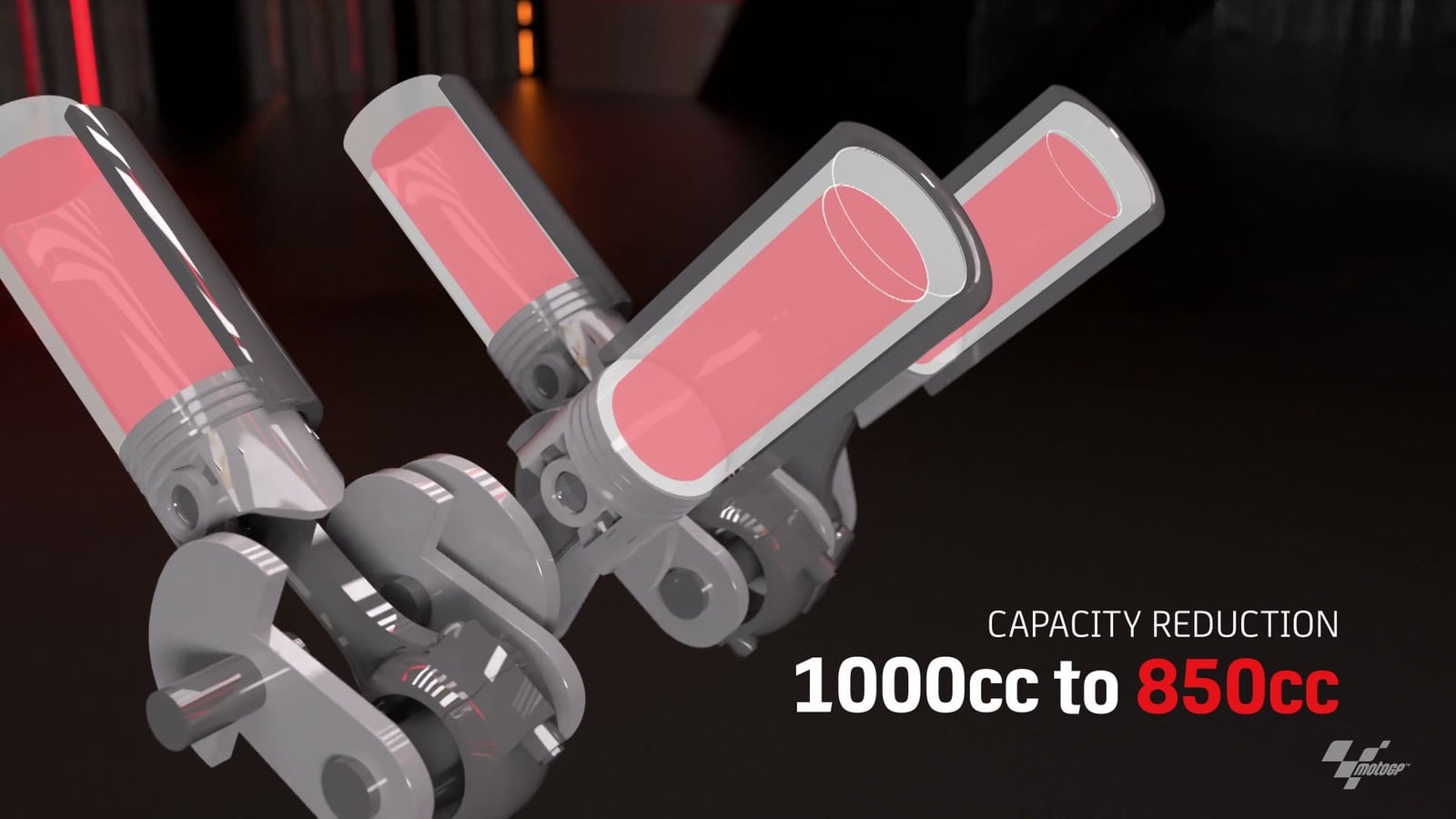
The engine goes from 1000cc to 850cc. Image: MotoGP
Less fuel, and all of it sustainable. The tank shrinks from 22 to 20 litres for a Grand Prix and from 12 to 11 litres for a Sprint. The fuel itself goes from at least 40% sustainable to 100%.
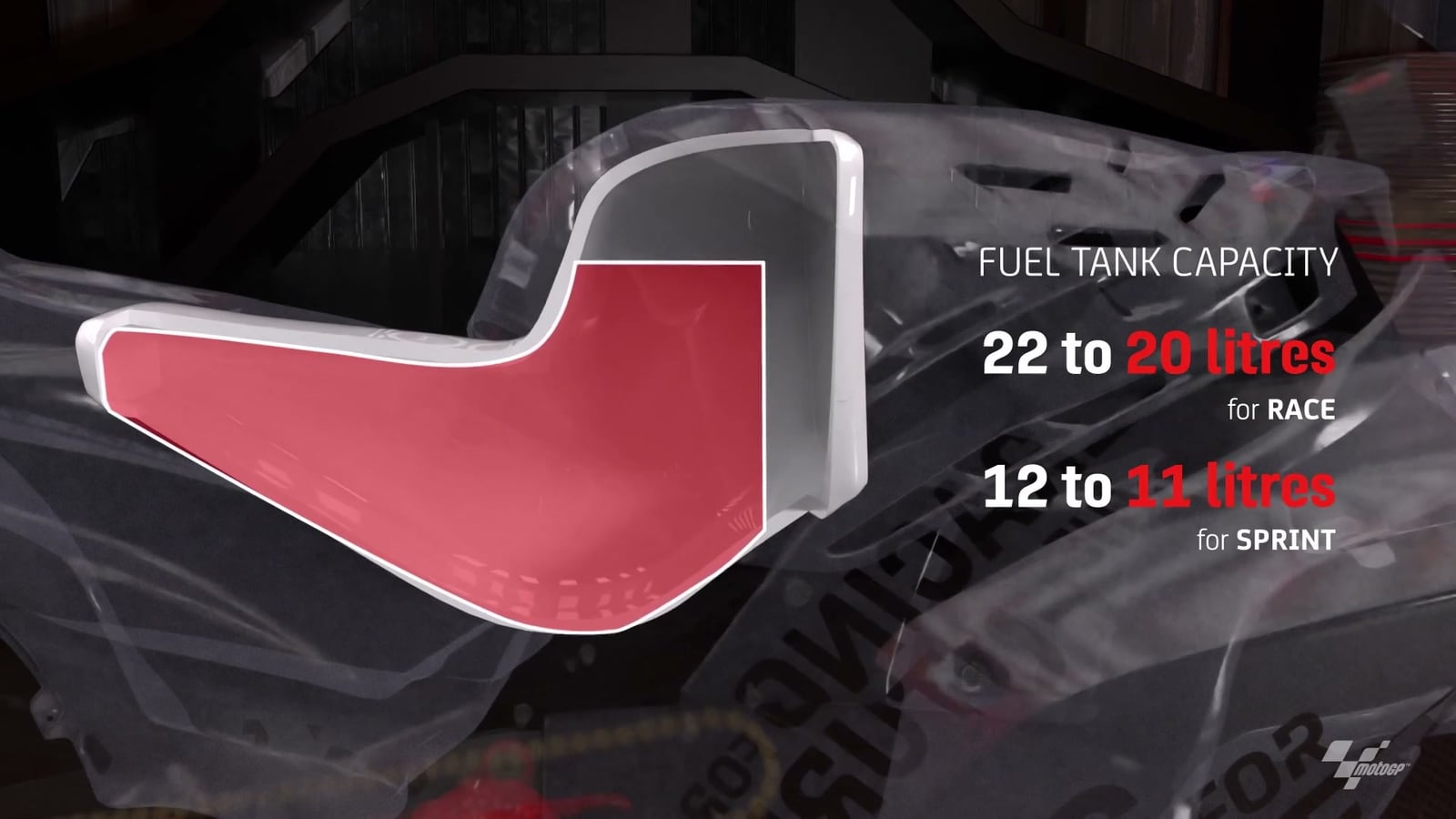
Smaller fuel tanks for the Grand Prix and the Sprint. Image: MotoGP
Banning ride-height devices means a bike no longer squats at the rear out of corners and on the straights. MotoGP says the ban should improve safety at race starts and put more weight on rider skill. Yamaha test rider Augusto Fernández says the bike feels “more like a real and natural bike” without them.
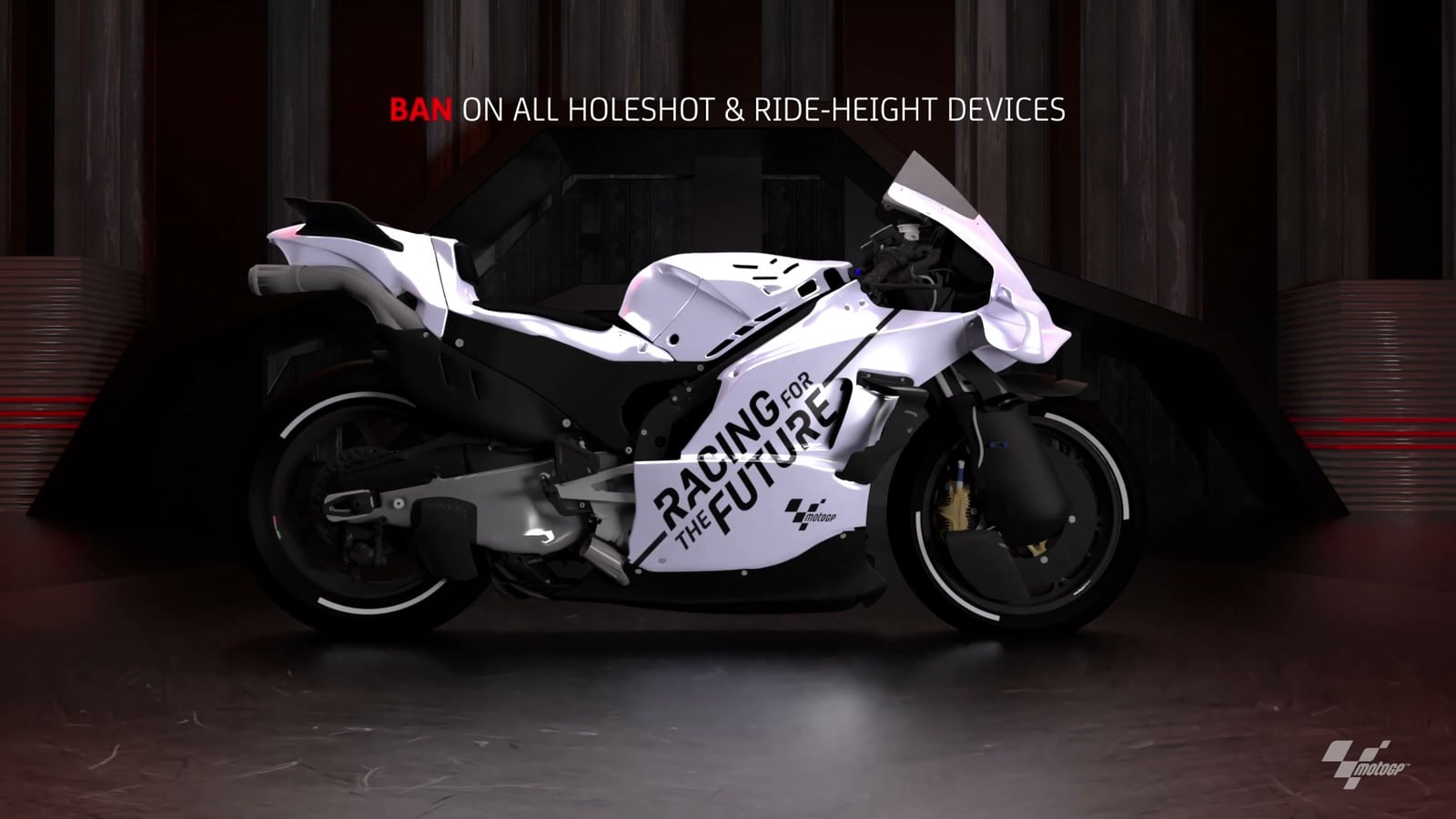
All holeshot and ride-height devices are banned. Image: MotoGP
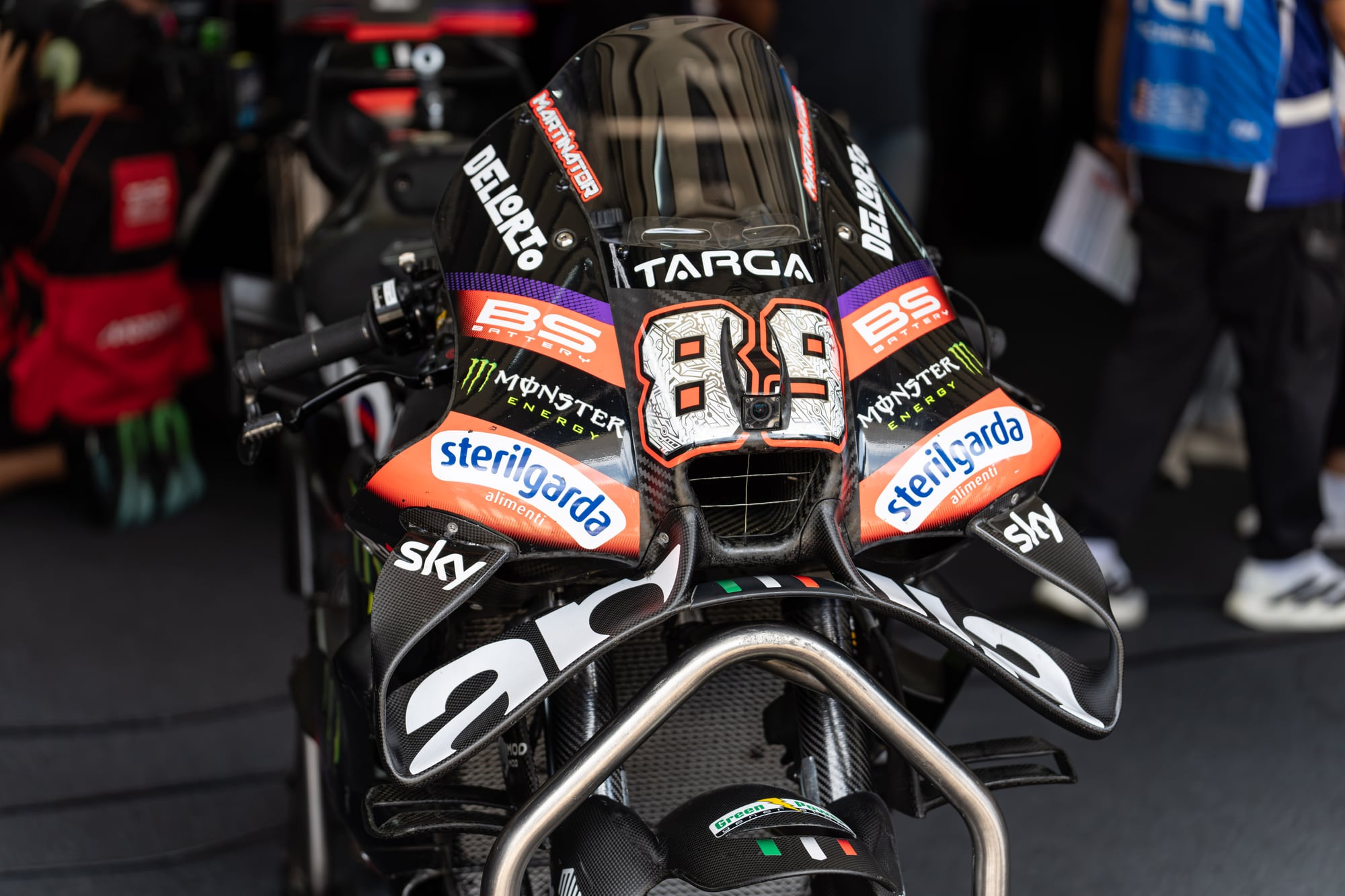
Less aero is there to reduce aero effects on the straights and in the braking zones, so riders can get close enough to pass. The top of the front fairing gets 50 mm narrower and the nose moves 50 mm back. The aero behind the rider also becomes part of the homologation, with one update allowed per season to keep costs down.
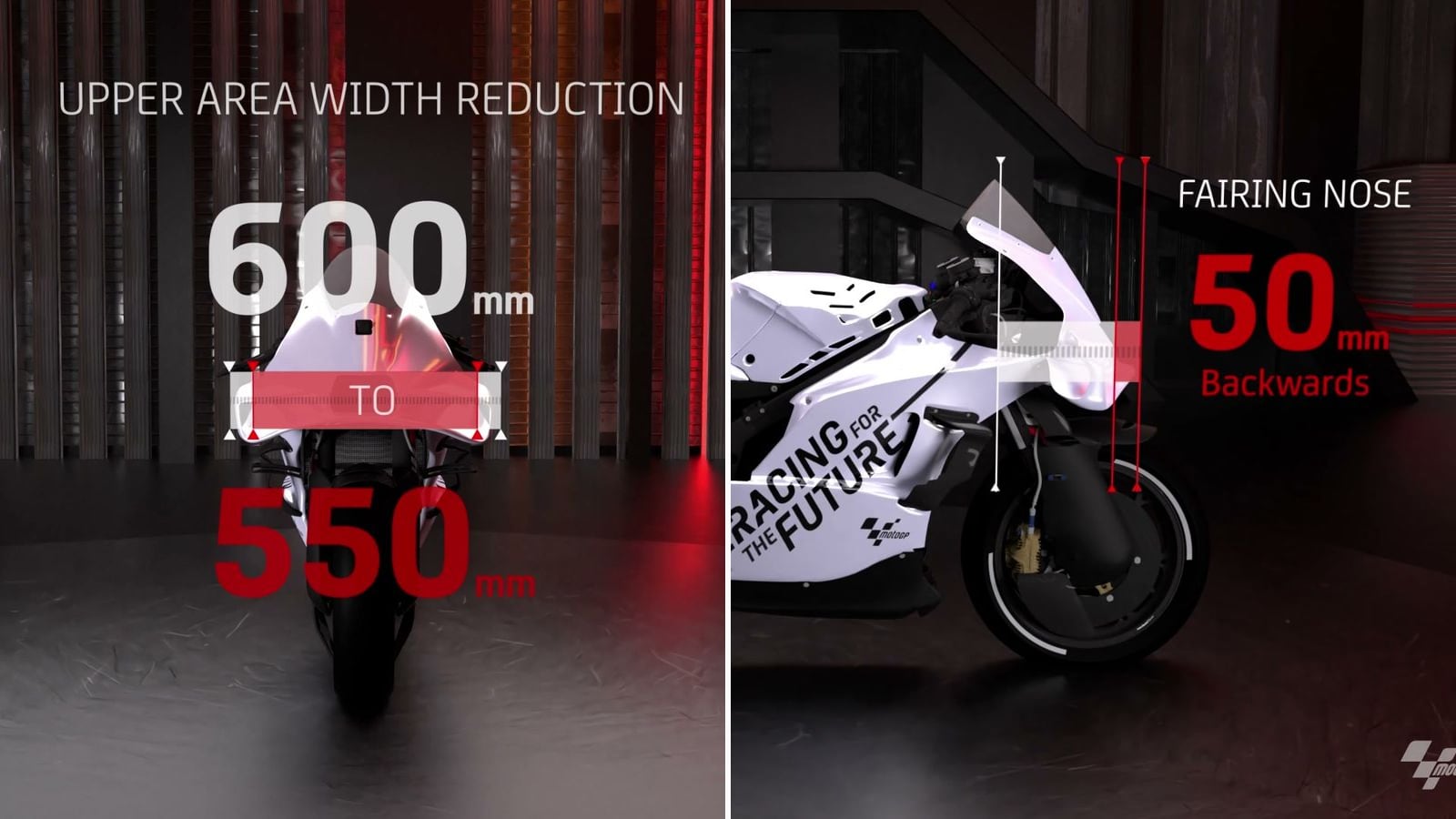
The front fairing narrows from 600 mm to 550 mm, left, and the nose moves back 50 mm, right. Image: MotoGP
Shared GPS data means every team gets every rider’s data after each session. MotoGP says that gives slower teams a cheaper way to catch up, helps safety and gives fans more insight.
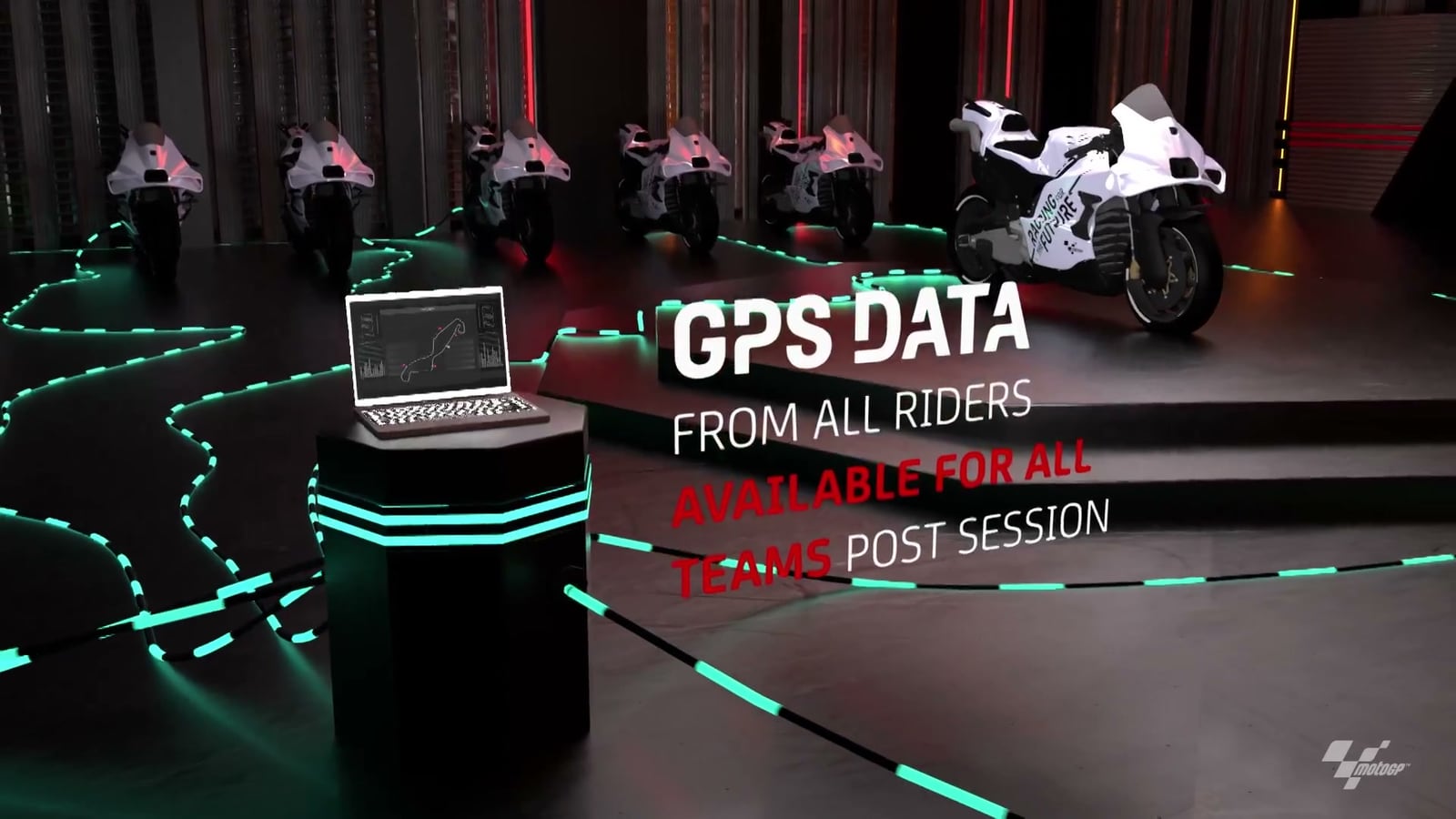
GPS data from all riders goes to all teams after each session. Image: MotoGP
Pirelli is the unknown. Its Giorgio Barbier wants a front tyre that gives riders feedback, and the unpopular tyre-pressure rule is set to be amended for 2027 and could go in 2028. “We don’t want to just cancel the [tyre-pressure] rule,” he said. After testing at Brno in June, Toprak Razgatlıoğlu said the front felt “like Superbike”, and that the rear had “incredible grip”, though it still needed work.
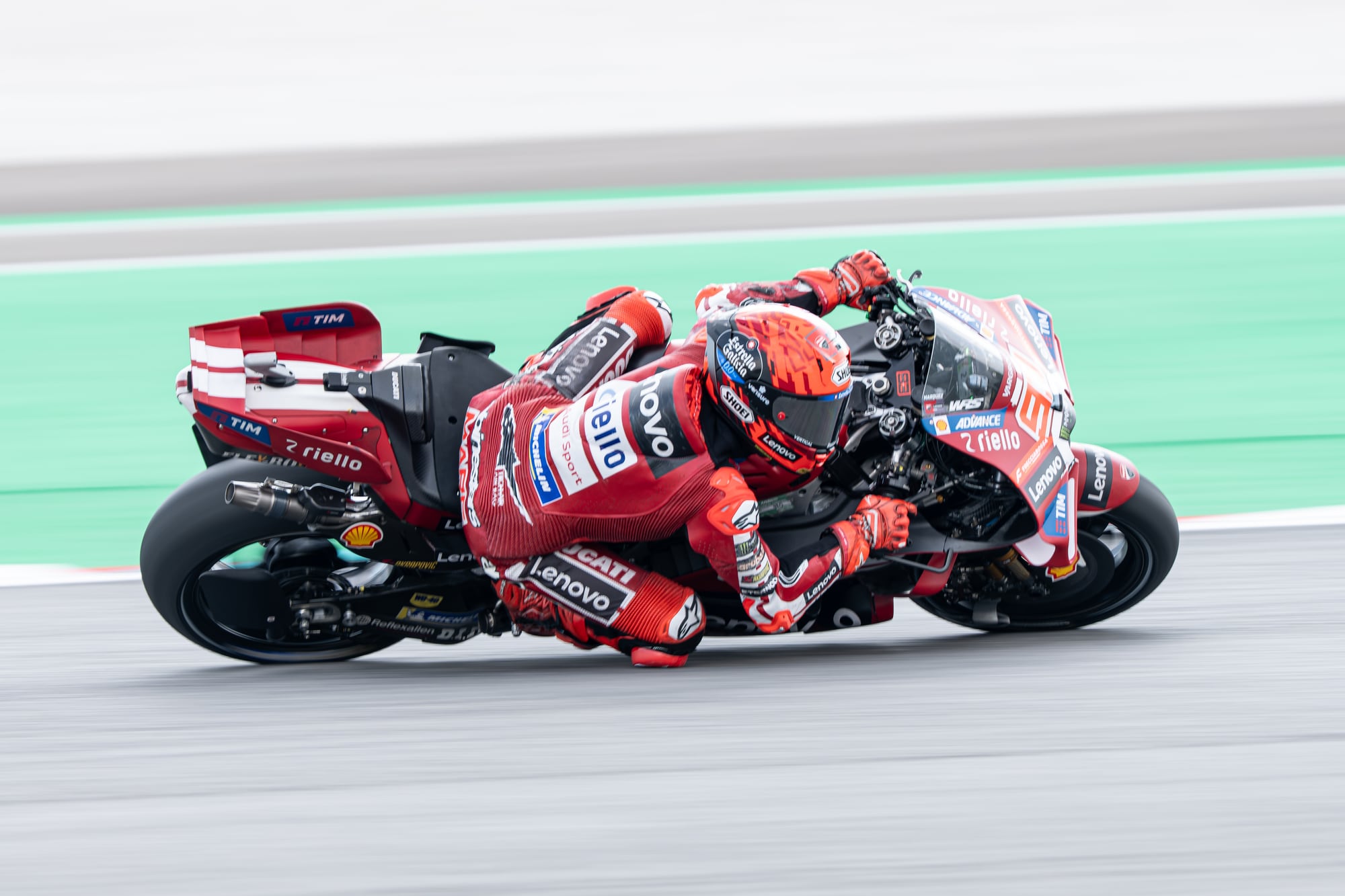
Marc Márquez rides through a fast corner during practice at the 2026 Malaysian MotoGP. Photo: Wan Mikhail Roslan/NurPhoto
How much slower will the new bikes be?
Nobody knows for sure yet, because there are no official times. But the predictions have moved a long way this year.
- January: MotoGP safety chief Loris Capirossi said manufacturers’ simulations pointed to bikes “1.5 to 2.5 seconds slower”.
- March: KTM’s Sebastian Risse said: “I think on half the tracks we might not go slower than now in terms of lap time.” He put the top speed loss in the range of 15 to 20 km/h. Márquez went further, predicting lap times “very similar, or even faster” at many circuits.
- June: Aleix Espargaró said the 850 and the 1000 “are closer than what people said”.
- September: Ducati test rider Nicolò Bulega said “the leap isn’t that dramatic”. He compared today’s roughly 350 km/h on fast tracks with the prototype’s speed, adding: “But 335 km/h is still not bad.”
The most useful number so far is from the Red Bull Ring, where riders tested a day after the Austrian Grand Prix.
| Red Bull Ring, September 2026 | Time |
|---|---|
| Jorge Martín, 1000cc, pole | 1:27.917 |
| Diogo Moreira, 850cc Honda, test | 1:28.4 |
| Pedro Acosta, 850cc KTM, test | 1:28.8 or 1:28.9 |
| Pedro Acosta, 1000cc, fastest race lap | 1:29.533 |
That puts an 850 only about half a second off a 1000cc pole, and quicker than the best lap of the race. Be careful with it, though. The test times are unofficial, and a test on one lap with new tyres isn’t a race.
Not everyone is convinced. Honda’s Romano Albesiano warned in June: “One should not attach too much importance to the performance figures currently being seen.” Aprilia’s Massimo Rivola added last month: “We don’t know if in race distance, if the time will be the same.”
The first officially timed test is at Valencia on 1 December, the first with the full 2027 line-up.
What the riders think
Mostly, they seem to like them. “It’s a lot more fun than the 1000 bike,” said Espargaró, who says the bike is more than 10 kg lighter and changes direction far more quickly. Joan Mir also called it “fun”, adding: “The corner speed also is higher. The [top] speed obviously is less.”
Razgatlıoğlu was blunter about the engine. “Power is less because after the 1000cc, with the 850… I feel very slow,” he said, before adding: “Okay, still it’s a fast bike.”
The 2027 line-up
The bikes aren’t the only reset. Pecco Bagnaia leaves Ducati for Aprilia, Pedro Acosta takes his seat next to Marc Márquez, Jorge Martín goes from Aprilia to Yamaha, Fabio Quartararo goes from Yamaha to Honda, and Álex Márquez goes from Gresini to KTM.
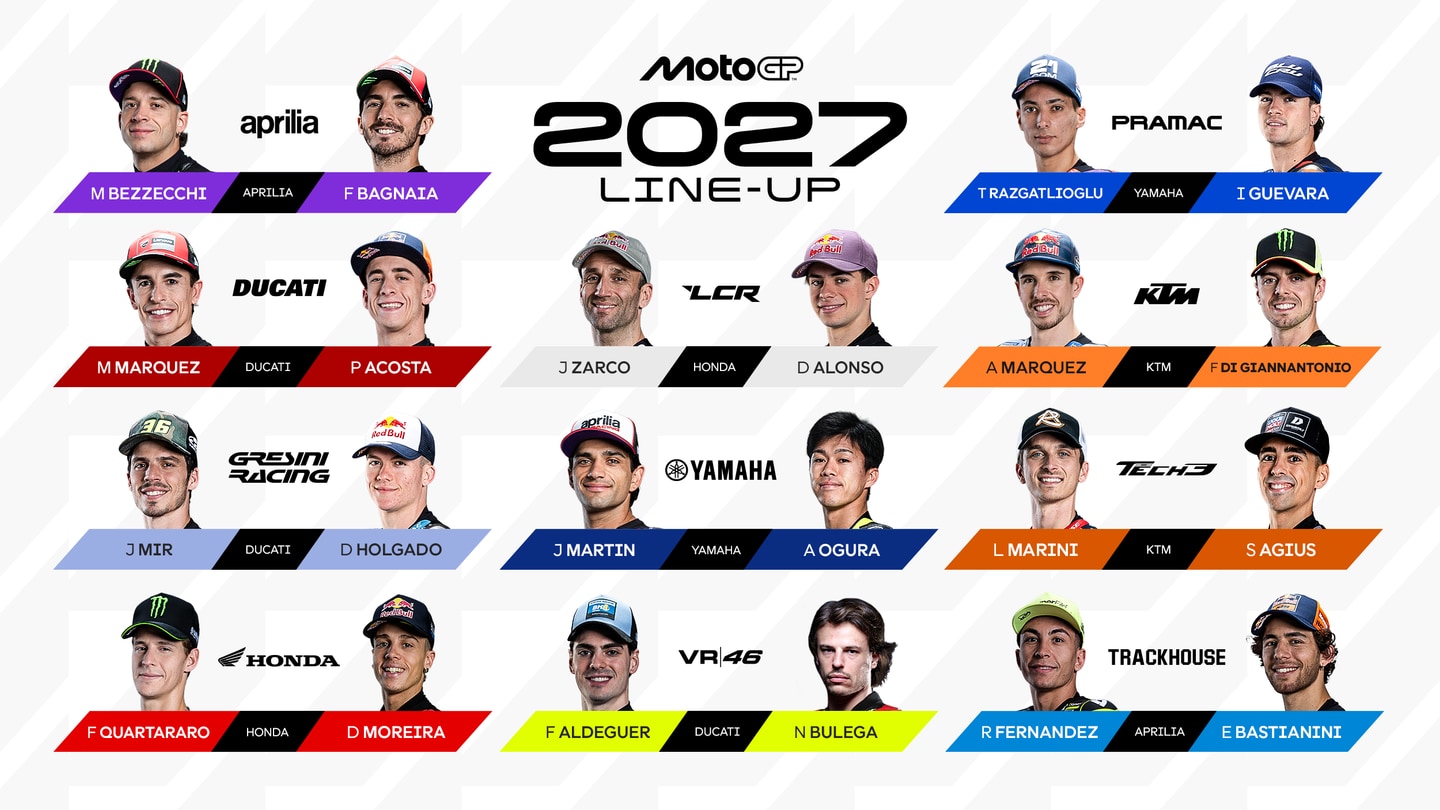
The 2027 MotoGP line-up. Image: MotoGP
| Team | Riders | Bike |
|---|---|---|
| Aprilia | Marco Bezzecchi, Pecco Bagnaia | Aprilia |
| Ducati | Marc Márquez, Pedro Acosta | Ducati |
| Honda | Fabio Quartararo, Diogo Moreira | Honda |
| KTM | Álex Márquez, Fabio Di Giannantonio | KTM |
| Yamaha | Jorge Martín, Ai Ogura | Yamaha |
| Gresini | Joan Mir, Daniel Holgado | Ducati |
| LCR | Johann Zarco, David Alonso | Honda |
| Pramac | Toprak Razgatlıoğlu, Izan Guevara | Yamaha |
| Tech3 | Luca Marini, Senna Agius | KTM |
| Trackhouse | Raúl Fernández, Enea Bastianini | Aprilia |
| VR46 | Fermín Aldeguer, Nicolò Bulega | Ducati |
Among this year’s riders not on the list are Brad Binder, Jack Miller, Álex Rins and Franco Morbidelli.
A new race weekend
Sprint qualifying arrives in 2027, so the Sprint and the Grand Prix will have separate grids at every round.
| Day | Session | Length |
|---|---|---|
| Friday | FP1 | 45 minutes |
| Friday | FP2 | 30 minutes |
| Friday | Sprint qualifying, all riders | 15 minutes |
| Saturday | FP3 | 20 minutes |
| Saturday | Grand Prix Q1, all riders | 15 minutes |
| Saturday | Grand Prix Q2, top 12 from Q1 | 15 minutes |
| Saturday | MotoGP Sprint | Race |
| Sunday | Moto3 and Moto2 Grands Prix | Races |
| Sunday | MotoGP Grand Prix | Race |
FP2 no longer decides who goes where, because it isn’t timed for entry into any other session. Sunday’s Warm Up goes too, replaced by a 10-minute window for sighting laps just before the race.
What else changes
- Everyone starts level on concessions. All manufacturers begin in Rank B and get reassessed in summer 2027. Wildcards are banned.
- There’s a new minimum wage. Riders are set to get at least €500,000 (about US$565,000) a year.
- The calendar moves. There are 22 Grands Prix from March to November, with Buenos Aires and a new street circuit in Adelaide joining.
Our view
“Slower” is probably the wrong word for these bikes. It looks like MotoGP will get the top speed cut it wanted, at around 15 to 20 km/h, without losing much lap time once the teams get on top of them. If the racing gets closer and the bikes are more fun to ride, that’s a good result.
The part we’d watch is safety. Top speed is only half of it. If riders get the lap time back by carrying more speed through corners, as Mir suggests, MotoGP will have moved some of the risk rather than removed it. Capirossi expects the speed to return anyway: as he says of 2007, when 800cc bikes replaced the 990s, “history will repeat itself”.
We’ll update this after the Valencia test on 1 December. New to the bikes? Start with our beginner’s guide to MotoGP for F1 fans.