F1 is going to Rwanda: 12 things to know about the African Grand Prix
A 6km track with 17 corners and nearly 200m of elevation change, next to a new airport, from 2030 at the earliest. Everything we know about F1's return to Africa, and the history behind it.
Formula 1 is going back to Africa. On 13 October, F1 announced a 10-year agreement to race at a brand-new circuit in Rwanda, with the first race expected in the early 2030s, possibly as soon as 2030.
Here’s what we know so far, and the history behind it.
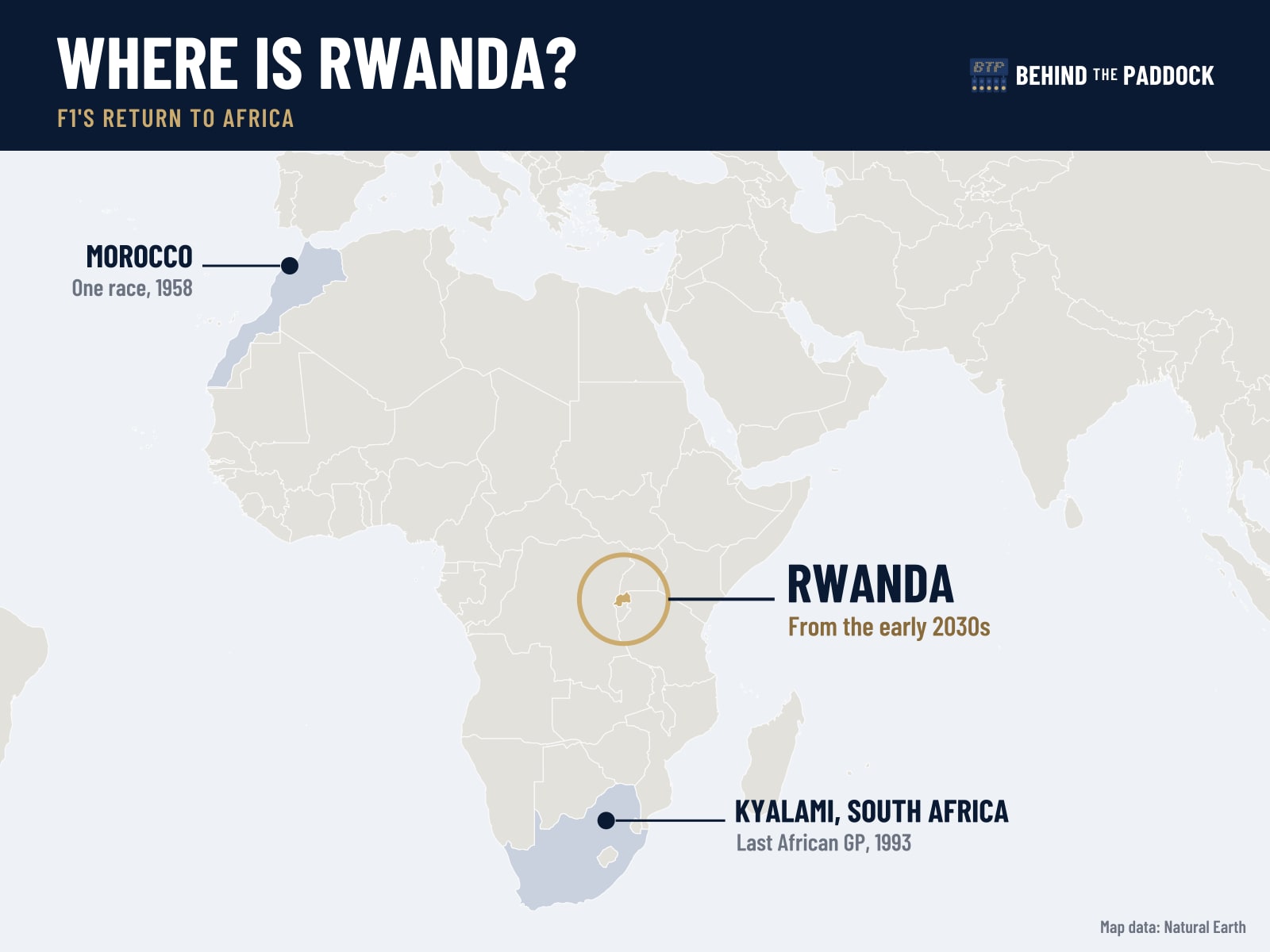
Rwanda sits in east-central Africa, just south of the equator. Morocco (1958) and South Africa (until 1993) are the only other African countries to have hosted F1. Map: Behind the Paddock, using Natural Earth data
1. It ends a wait of nearly 40 years
F1’s last race in Africa was the 1993 South African Grand Prix at Kyalami, won by Alain Prost. If Rwanda’s first race happens in 2030, the gap will be 37 years.
2. F1 will race on every inhabited continent
Africa was the only inhabited continent missing from the calendar. As George Russell put it, it was “the only continent we don’t race on.”
3. The track: 6km, 17 corners and a lake
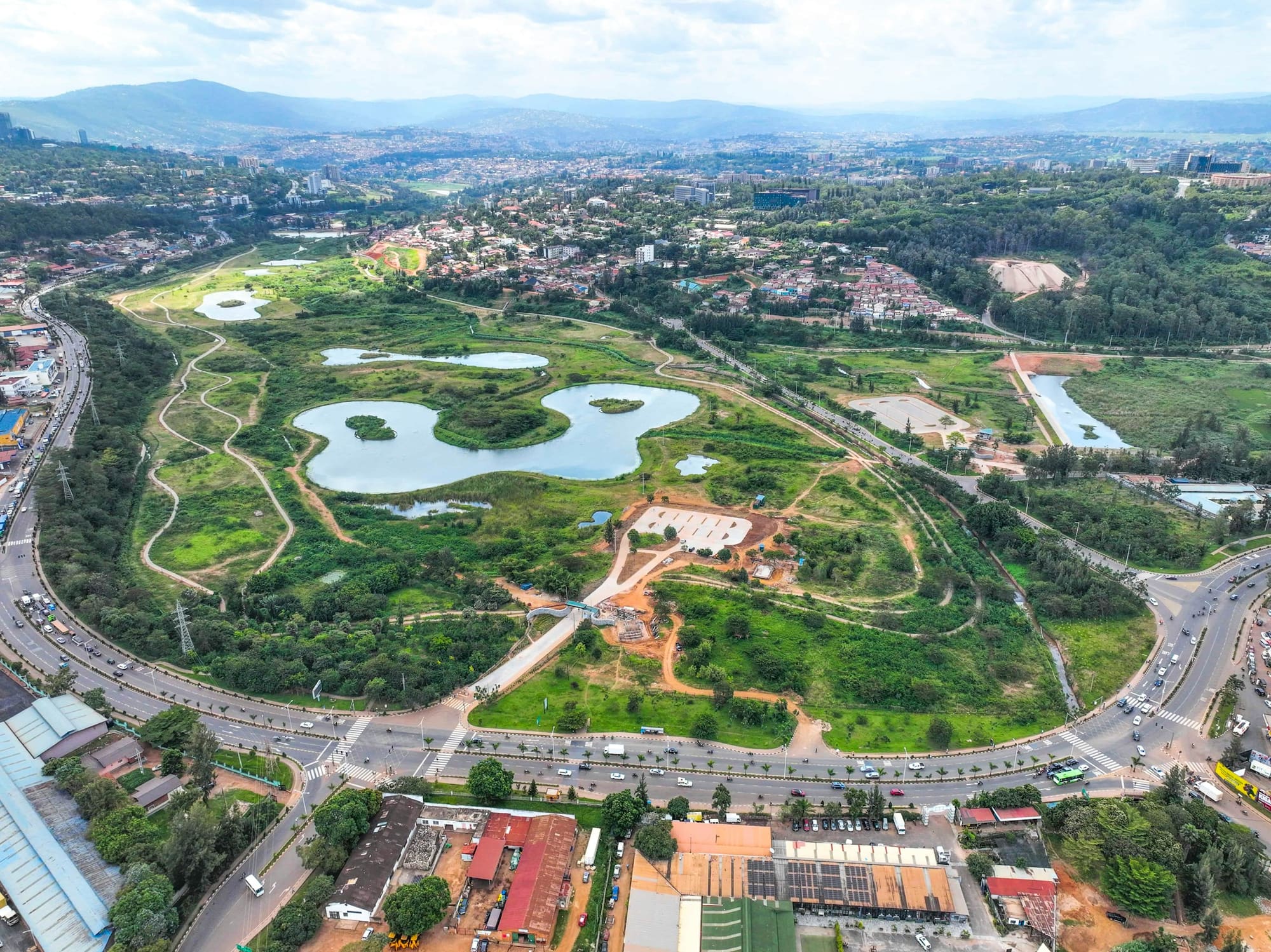
The layout isn’t final yet, but the plan is for a 6km, 17-corner, anti-clockwise circuit, built around two hills and a lake. Expect cambered corners and banking.
4. Nearly 200 metres of elevation change
Each lap will climb and fall 197 metres. Rwanda isn’t called the “land of a thousand hills” for nothing. Designer Alex Wurz says the site designed itself: “the nature designed already the perfect topography.”
5. Designed by an ex-F1 driver and the team behind Sepang
The track is a collaboration between former F1 driver Alex Wurz’s WurzDesign and Tilke Engineers and Architects, who designed Sepang and several other F1 circuits. Wurz has taken inspiration from classics like Spa, Suzuka and Mugello, and Tilke calls the result “a roller coaster track.”
6. You could land and walk to the paddock
The circuit will be built in Bugesera, about 40km south of Kigali, right next to the new Kigali International Airport, which is due to open in early 2028.
7. It’s been almost 10 years in the making
F1’s owners Liberty Media have wanted a race in Africa since buying the sport in 2017. Morocco and South Africa were both in the running, but Rwanda was the one to put together a single, fully funded plan.
8. Lewis Hamilton has been pushing for this for years
Hamilton has been one of the loudest voices for an African race. “For the past six years I’ve been fighting in the background to get a grand prix,” he said earlier this year, naming Rwanda as one of the places that was “particularly spectacular.”
9. Max Verstappen has already collected a title in Kigali
Rwanda hosted the FIA’s end-of-season awards in 2024, where Verstappen picked up his fourth world championship trophy. The country has also hosted cycling’s Road World Championships and the 2023 FIFA Congress.
10. Only three African countries will have hosted F1
Morocco held one world championship race, in 1958, where Mike Hawthorn clinched the title. South Africa hosted on and off until 1993. Rwanda will be the third.
11. Africa’s F1 fanbase is huge
F1 says it has more than 100 million fans across Africa, with almost 60% of fans in key Sub-Saharan markets under 35.
12. Visit Rwanda is no stranger to big sport
The race will be called the Formula 1 African Grand Prix, presented by Visit Rwanda. The tourism brand is already familiar to football fans from the shirts of Arsenal, Paris Saint-Germain and Bayern Munich.
Not everyone is cheering
The deal is likely to be controversial. Rwanda has previously been accused of sportswashing, using major sporting events to improve its image. The government says the project is funded through a new development fund combining public and private investment.
What they said
Paul Kagame, President of Rwanda: “Today belongs to Africa.”
Stefano Domenicali, F1 CEO: “Today is a landmark moment for Formula 1.”
Mohammed Ben Sulayem, FIA President: “The return of the FIA Formula 1 World Championship to Africa is a historic moment for our sport.”