New to F1? A beginner's guide for anyone going to their first Grand Prix
Got an F1 ticket but don't follow the sport? F1 explained simply: how a race weekend works, how a race is won, the new 2026 rules, flags, tyres, and how to follow it all from your seat.
So someone gave you a ticket to a Formula 1 race. Maybe from a friend, maybe from work. Good news: you don’t need to know anything to have fun. Twenty-two cars flying past at 300 km/h does the job on its own.
But a few basics make it way better. You’ll know why the crowd groans at a yellow flag, and what everyone is shouting about.
This guide starts from zero. Every bit of jargon is explained.
The 60-second version
- 22 drivers, 11 teams. Two cars per team.
- Friday is practice. Saturday is qualifying. Sunday is the race.
- Qualifying is a speed test. It decides who starts where.
- The race is about 305 km. It takes around 90 minutes.
- The top 10 score points. A win is worth 25.
- There are two titles: best driver and best team.
- Everyone stops for new tyres at least once, unless it rains.
- Bring earplugs. Get the F1 app. Find a big screen.
What F1 actually is
F1 is the top level of motor racing. Think Premier League or NBA, but with cars. The season runs from March to December, with around two dozen races worldwide.
The big twist: every team builds its own car. So the cars aren’t equal. Even a great driver can’t win in a slow car.
There are two championships, like two league tables that run all year:
- Drivers’ championship. The driver with the most points at the end is world champion. This year it’s Kimi Antonelli of Mercedes. He sealed it in Mexico at 20, the youngest champion ever. Lando Norris of McLaren won in 2025.
- Constructors’ championship. “Constructor” just means team. Both drivers’ points are added up. It decides the prize money, so teams care a lot.
The teams and drivers in 2026
Here’s the whole grid: 11 teams, two drivers each.
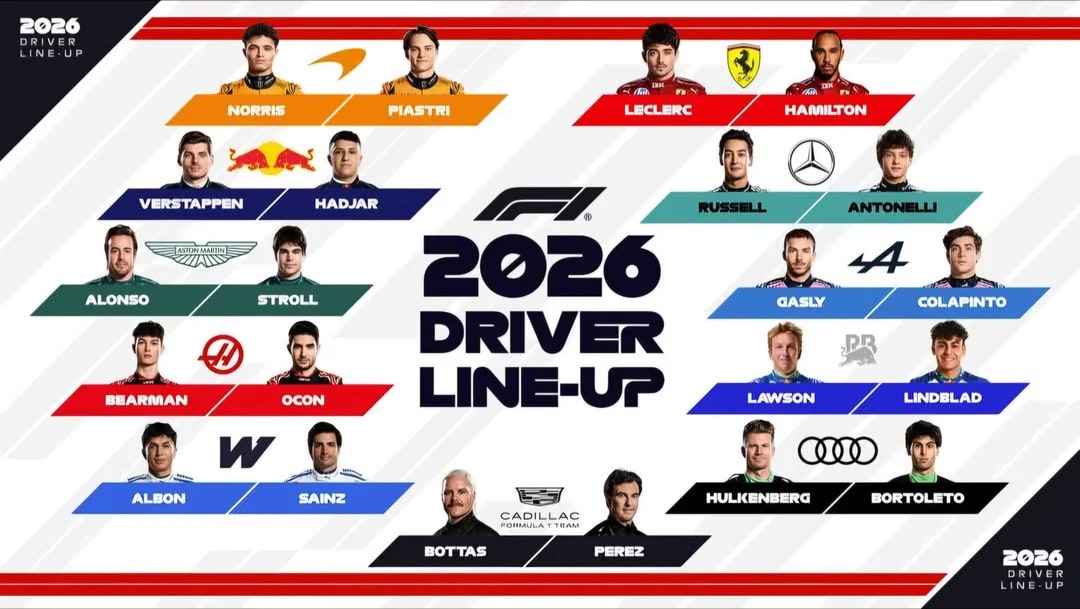
The 2026 line-up as the season started. Rafael Camara has since replaced Esteban Ocon at Haas. Image: Formula 1
Spot the teams by their colours. To tell team-mates apart, look at the small camera above the driver’s head. It’s black on one car and yellow on the other.
| Team | Drivers | Look for |
|---|---|---|
| McLaren | Lando Norris, Oscar Piastri | Papaya orange |
| Ferrari | Charles Leclerc, Lewis Hamilton | Red |
| Mercedes | Kimi Antonelli, George Russell | Black and silver |
| Red Bull | Max Verstappen, Isack Hadjar | Dark blue with red and yellow |
| Aston Martin | Fernando Alonso, Lance Stroll | Green |
| Williams | Alex Albon, Carlos Sainz | Blue |
| Alpine | Pierre Gasly, Franco Colapinto | Blue and pink |
| Racing Bulls | Liam Lawson, Arvid Lindblad | White with black and blue |
| Haas | Oliver Bearman, Rafael Camara | White, black and red |
| Audi | Nico Hulkenberg, Gabriel Bortoleto | Silver, black and red |
| Cadillac | Sergio Perez, Valtteri Bottas | Half black, half white |
Cadillac is new this year, so the grid grew from 20 cars to 22. Rookie Rafael Camara joined Haas in Brazil, and he’s signed for 2027 too.
Names worth knowing:
- Max Verstappen (Red Bull): four titles in a row, 2021 to 2024.
- Lewis Hamilton (Ferrari): seven titles, and the most race wins ever.
- Fernando Alonso (Aston Martin): two titles. At 45, the oldest driver racing.
- George Russell (Mercedes): Antonelli’s main title rival this year.
How a race weekend works
A normal weekend
Friday: practice. Two one-hour sessions. It’s the warm-up before the exam, and nothing counts. It’s also the cheapest, quietest day, so it’s great for exploring the track.
Saturday: practice, then qualifying. Fastest lap starts at the front. Qualifying has three knockout rounds:
- Q1: all 22 cars run. The slowest six are out. They start 17th to 22nd.
- Q2: 16 cars run. Six more are out. They start 11th to 16th.
- Q3: the top 10 fight for pole position: starting first.
With 22 cars this year, six drop out in each round instead of five.
Here’s the end result: F1’s grid for the 2026 São Paulo Grand Prix. Each row is in team colours.
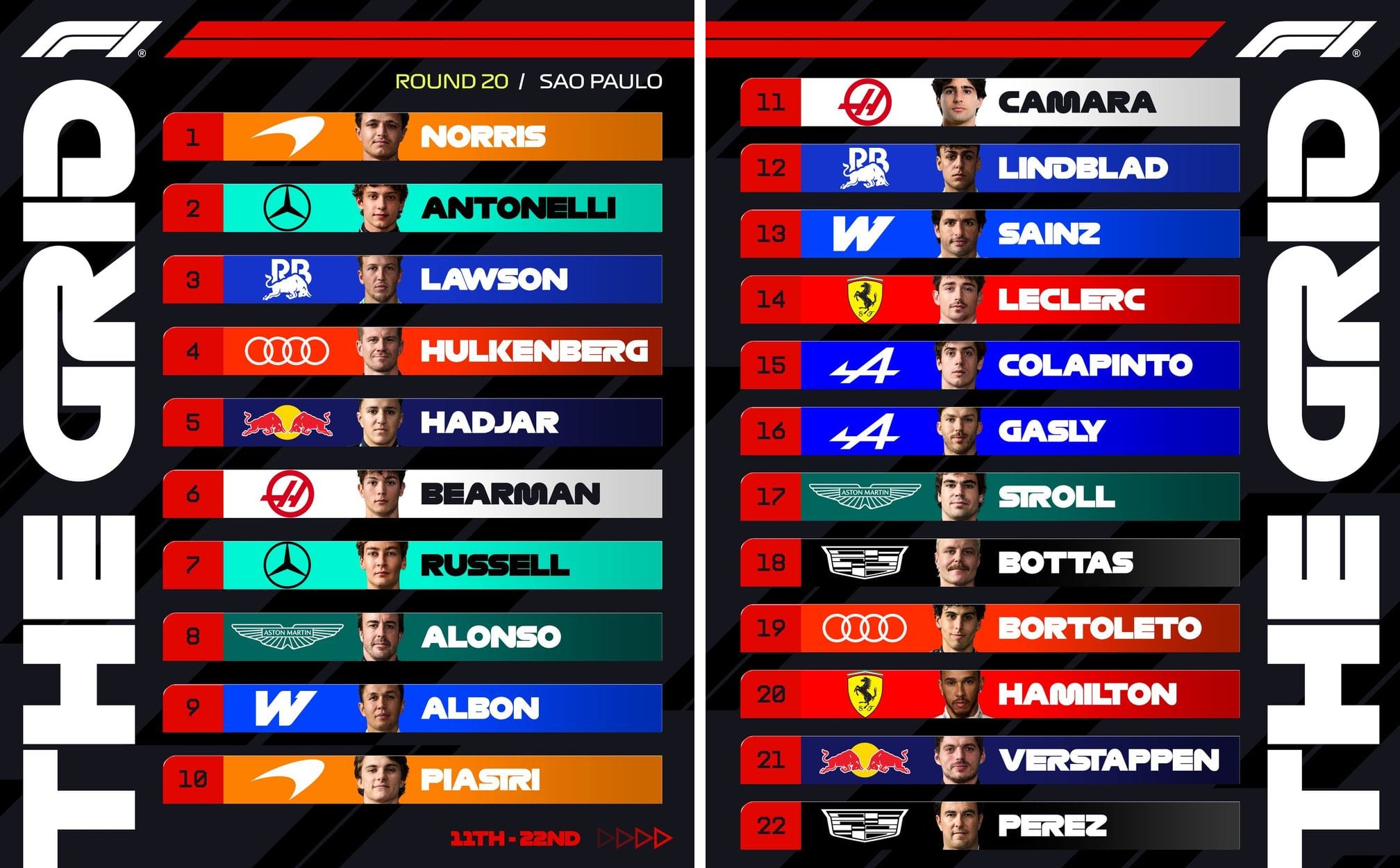
The starting grid for the 2026 São Paulo Grand Prix. Image: Formula 1 on Instagram
Sunday: race day. First, a drivers’ parade, where they wave to the crowd from a truck or classic cars. Then the national anthem. Then the race.
A Sprint weekend
Six weekends a year add a Sprint: a short extra race of about 100 km on Saturday. In 2026 they were China, Miami, Canada, Britain, the Netherlands and Singapore.
- Friday: practice, then Sprint Qualifying.
- Saturday: the Sprint, then normal qualifying.
- Sunday: the main race.
Going on Saturday? A Sprint weekend gives you a real race too.
One exception: Las Vegas runs Thursday to Saturday, with the race on Saturday night. See our Las Vegas guide.
Only going one day? Sunday has the race. Saturday has qualifying and a big atmosphere. Friday is cheapest, with the most time watching cars.
How the race works
The start. Cars line up in qualifying order. They do one slow lap first, the formation lap, to warm their tyres. Then five red lights come on, one by one. When they all go out, the race starts. That’s “lights out”. It’s the best moment of the day, so don’t miss it.
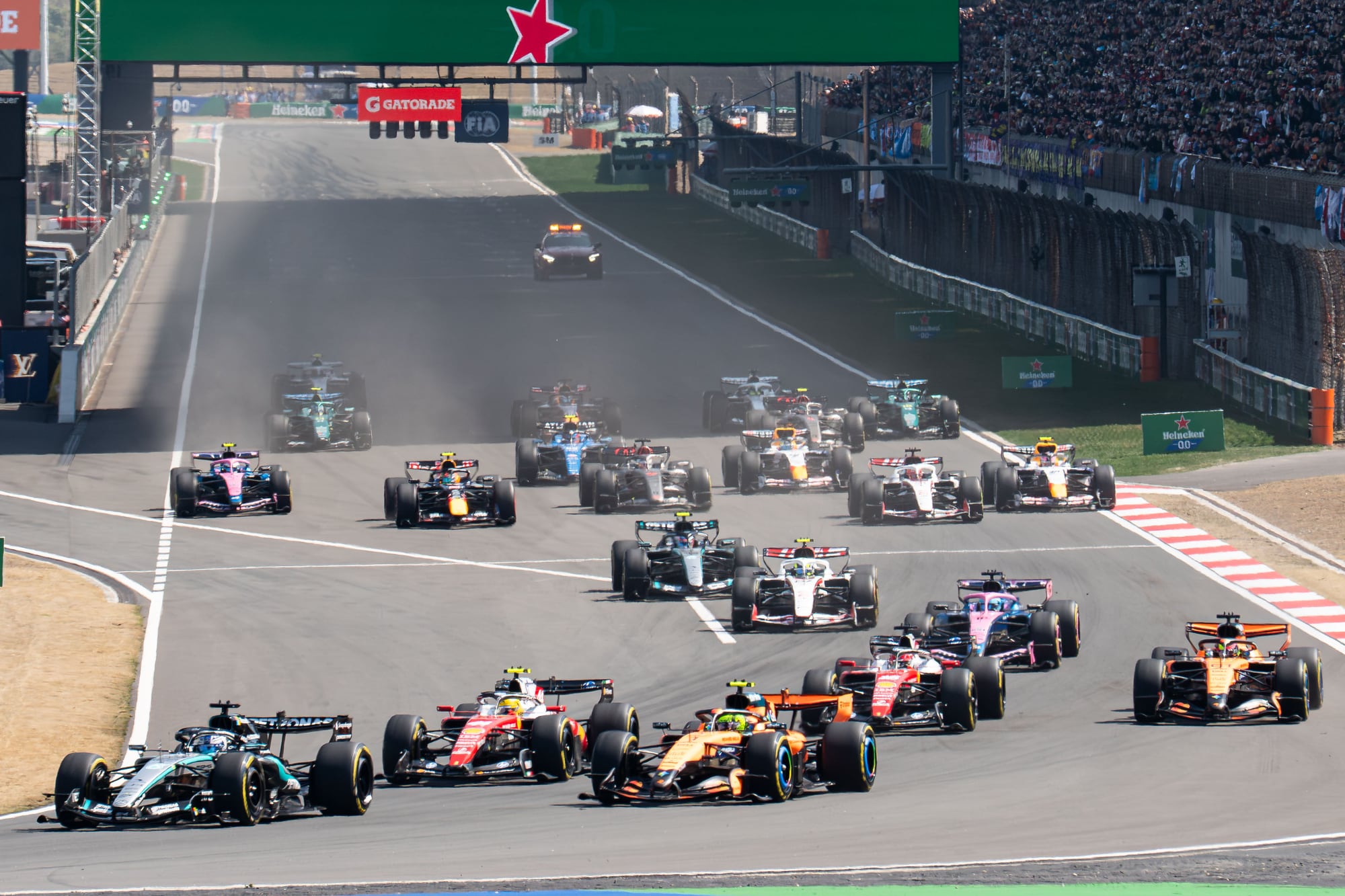
Cars head to Turn 1 at the start of the 2026 Chinese Grand Prix Sprint. Photo: Wan Mikhail Roslan/ZUMA Press
How long. Every race is about 305 km, so laps depend on the track: 50 in Las Vegas, 71 in Brazil. Monaco is shorter, at about 260 km. No race can last over two hours.
Pit stops. In a dry race, drivers must use two types of tyre. So everyone stops at least once. About 20 mechanics change all four wheels in two or three seconds. But the trip through the pit lane costs about 20 seconds. When to stop is one of the race’s biggest decisions.
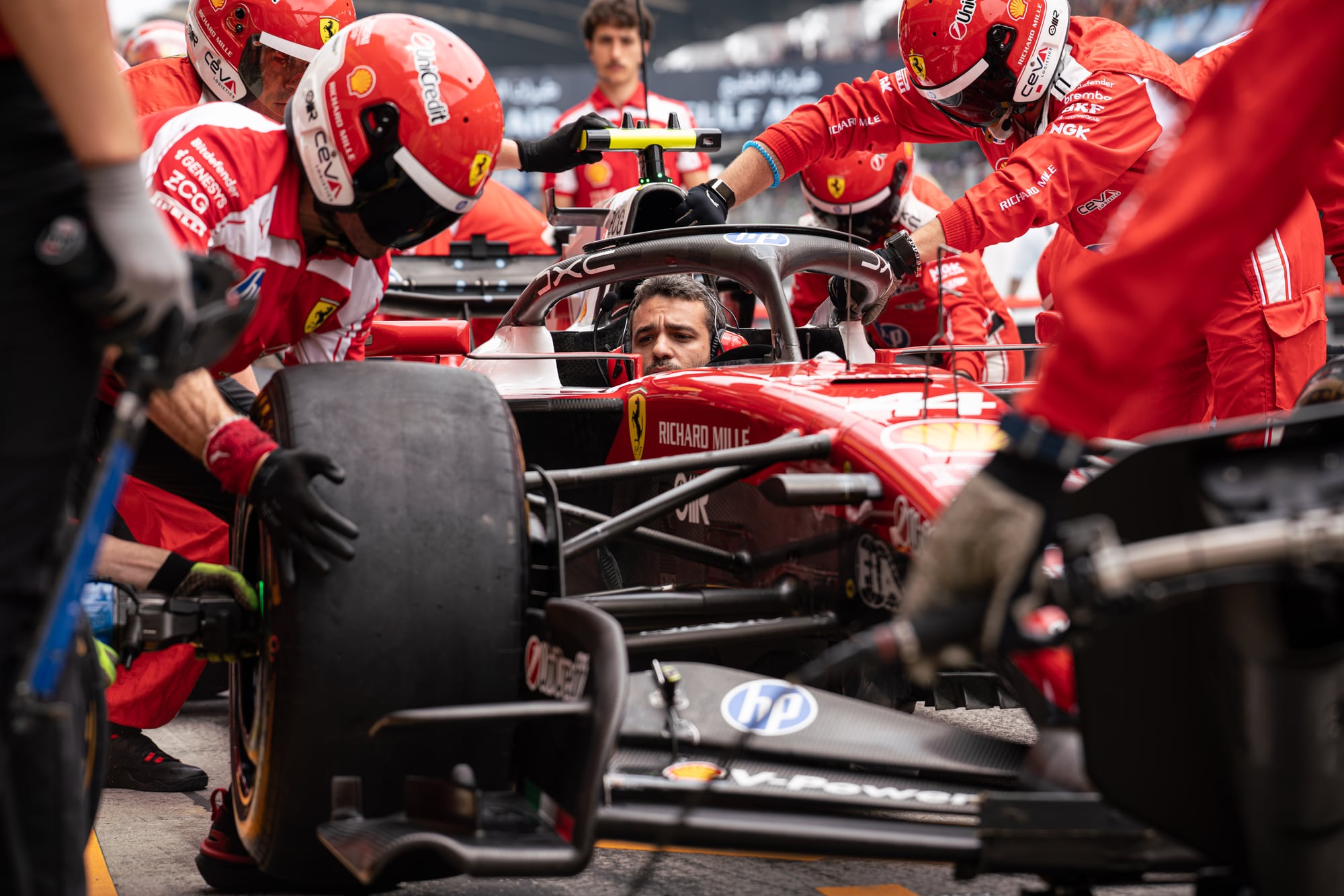
Ferrari mechanics at work during the 2026 Bahrain Grand Prix at Sepang. Photo: Wan Mikhail Roslan/NurPhoto
Points. The top 10 score in a race. The top eight score in a Sprint.
| Finish | Race | Sprint |
|---|---|---|
| 1st | 25 | 8 |
| 2nd | 18 | 7 |
| 3rd | 15 | 6 |
| 4th | 12 | 5 |
| 5th | 10 | 4 |
| 6th | 8 | 3 |
| 7th | 6 | 2 |
| 8th | 4 | 1 |
| 9th | 2 | 0 |
| 10th | 1 | 0 |
The bonus point for the fastest lap was dropped in 2025.
After the chequered flag (the black-and-white checked flag that ends the race), the top three get trophies and a champagne spray on the podium. At many tracks, fans can then walk onto the track to watch. If you can, do it.
Tyres
All teams use Pirelli tyres. Each type has a coloured stripe on the side:
- Soft (red): fastest, but wears out quickest.
- Medium (yellow): in between.
- Hard (white): slowest, but lasts longest.
- Intermediate (green): for a damp track.
- Wet (blue): for heavy rain.
Think sprinting versus jogging. Softs are quick but don’t last. Hards last but are slower. The team’s plan for mixing them is called the strategy. The two-types rule doesn’t apply in the rain.
Before each race, Pirelli shares the strategies it expects. Here are two from Mexico. Left: one stop, yellow mediums then red softs. Right: two stops, red softs, yellow mediums, red softs. More stops cost more time, but give fresher, faster tyres.
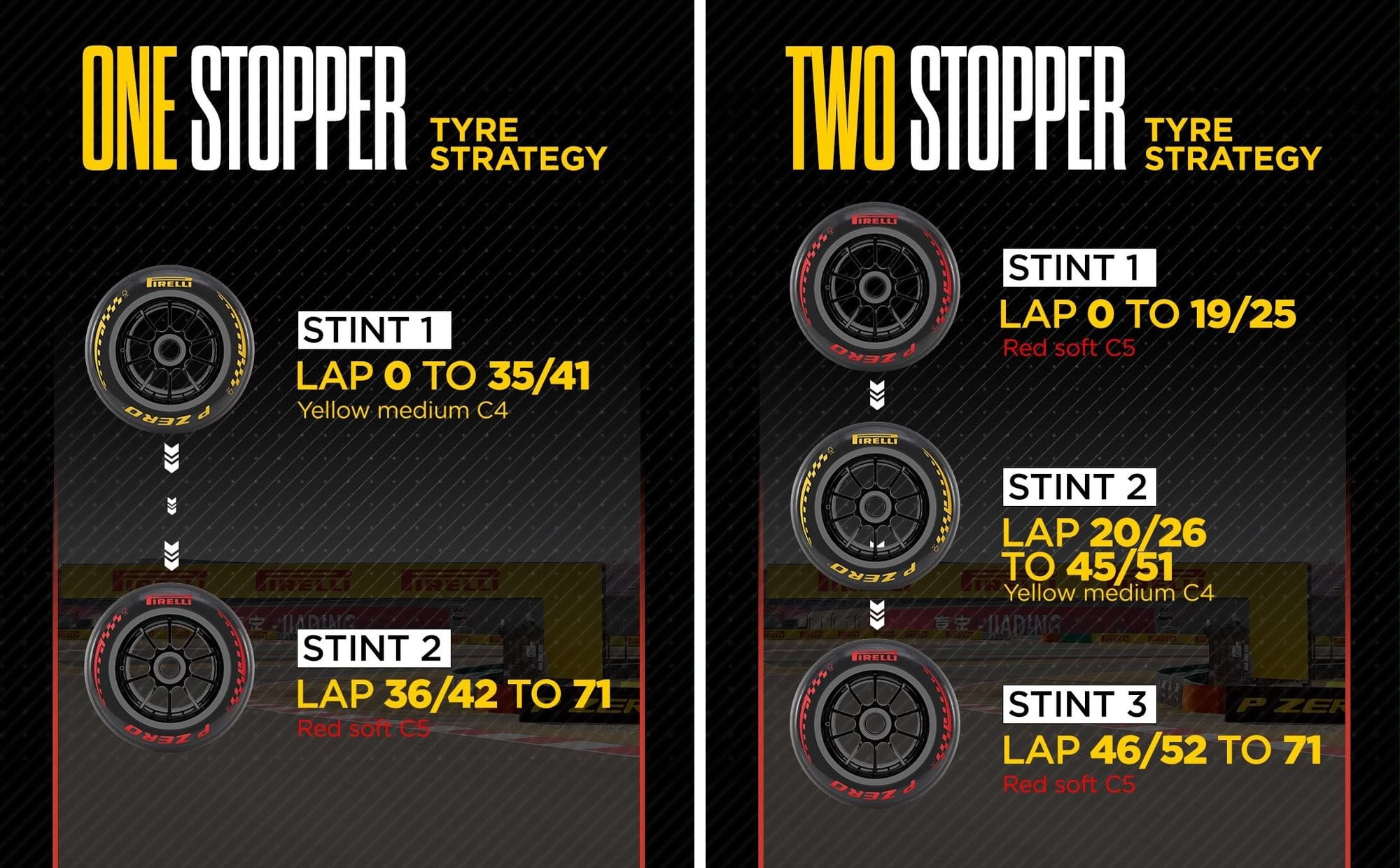
Pirelli’s one-stop and two-stop strategies for the 2026 Mexico City Grand Prix. Image: Pirelli Motorsport on Instagram
You can see the stripe as cars pass, and the big screens show each driver’s tyres.
Flags, the Safety Car and penalties
Track officials, called marshals, wave flags to tell drivers what’s happening. The same colours light up on panels by the track.
| Flag | What it means |
|---|---|
| Green | All clear |
| Yellow | Danger ahead. Slow down, no overtaking |
| Red | Everything stops. Cars go back to the pit lane |
| Blue | A faster car is lapping you. Let it past |
| Red and yellow stripes | Slippery track |
| White | Slow vehicle ahead, like a recovery truck |
| Black and white | Warning for bad driving, like a yellow card |
| Black with an orange circle | Car is damaged. Pit and fix it |
| Black | Disqualified, like a red card |
| Chequered | Race over |
Heavy rain can stop things too. The start gets delayed, or the session is red-flagged until it eases.
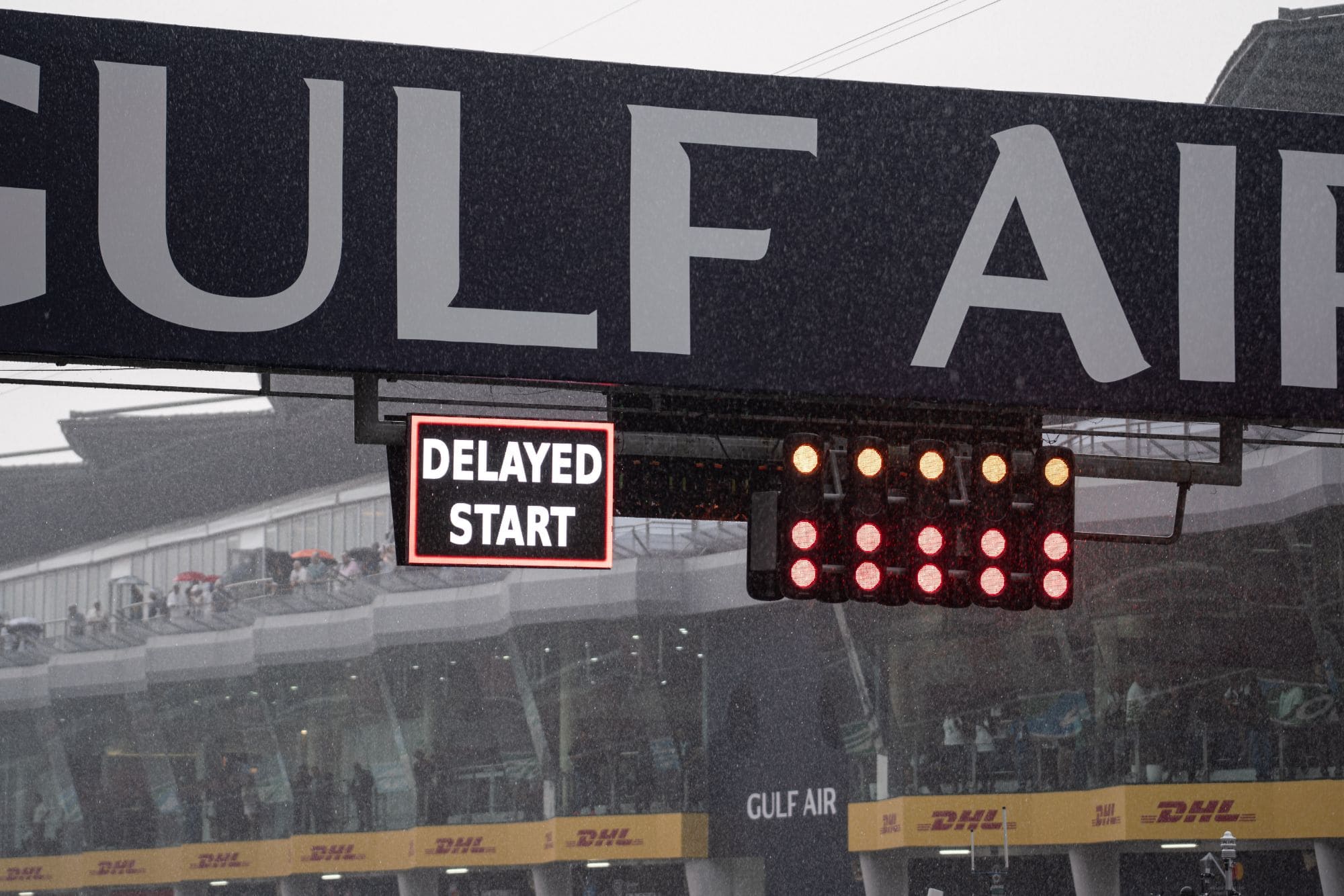
A Delayed Start board in heavy rain at the 2026 Bahrain Grand Prix at Sepang. Photo: Behind the Paddock
The Safety Car comes out after a crash or when there’s debris. Everyone lines up behind it, and nobody can overtake. That closes up all the gaps, so the restart is often wild. Stay in your seat.
The Virtual Safety Car (VSC) is a lighter version. There’s no car on track. Everyone just slows to a set speed.
Penalties come from the stewards, F1’s referees. The common ones:
- 5 or 10 seconds: added to a driver’s time. Finish third on the road, and you could drop to fifth.
- Drive-through: drive through the pit lane without stopping. It costs about 20 seconds.
- Grid penalty: start further back, often for using too many engine parts. In Brazil, Verstappen, Hamilton, Leclerc, Russell and Perez all got one. That’s why some big names sit so far back on the grid above.
- Track limits: stay inside the white lines. Go over too often, and you get a time penalty.
How to follow the race from your seat
Nobody tells first-timers this: you see less of the race at the track than on TV. Your corner looks amazing, then the cars vanish for the rest of the lap.
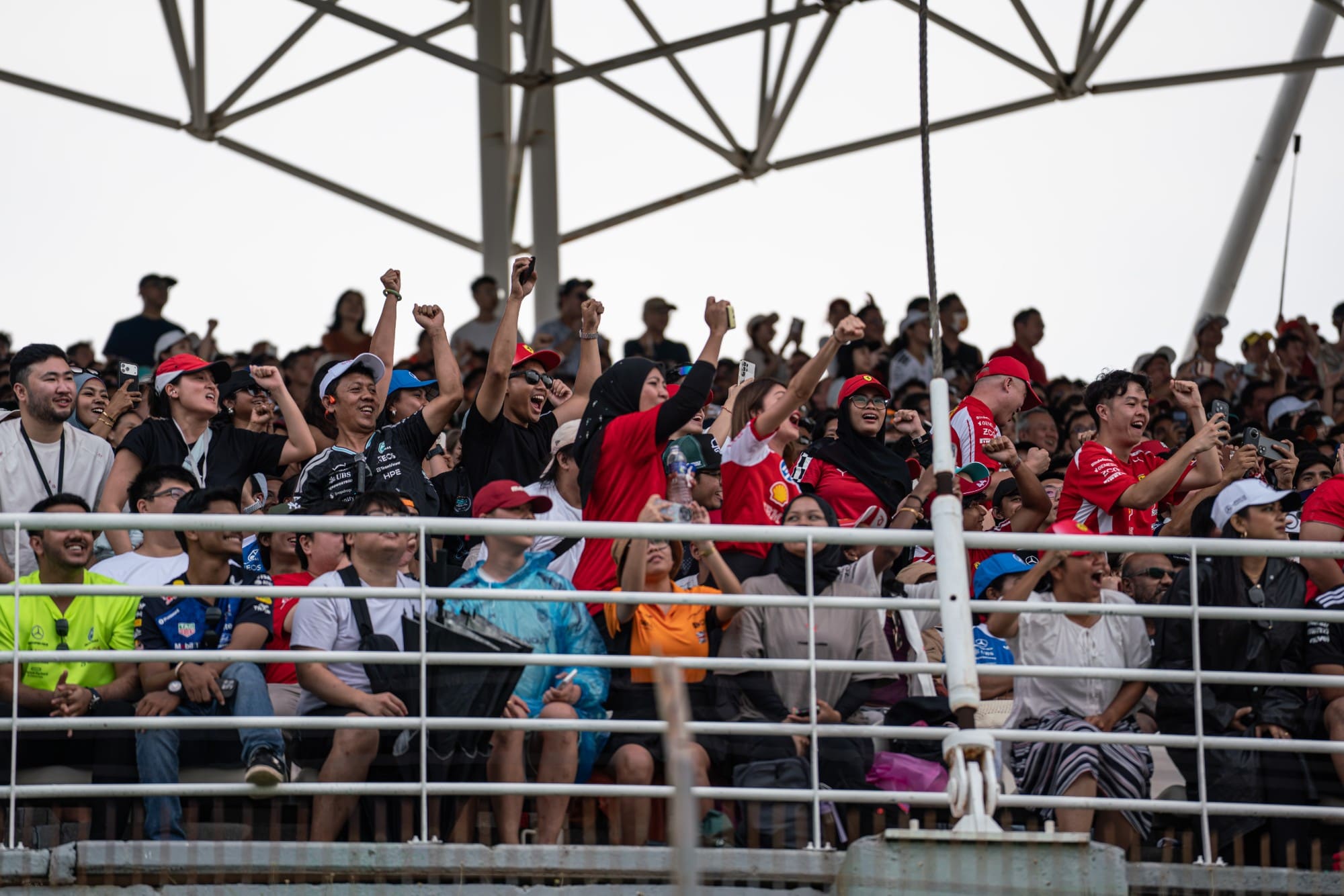
Fans cheer in the grandstand at the 2026 Bahrain Grand Prix at Sepang. Photo: Behind the Paddock
These help:
- Find a big screen. Check you can see one from your seat. It shows the TV feed and the running order.
- Get the official F1 app. The free version shows the timetable and live order. F1 TV adds commentary. In the US, it comes with Apple TV this year.
- Expect bad signal. 100,000 people means slow data. Save your tickets and a map before you go.
- Learn the timing colours. Purple is the fastest of anyone. Green is a driver’s own best. Yellow is slower.
- Watch the start, the pit stops and the last laps. That’s where the action is.
What else happens at the track
- Support races. F2, F3, F1 Academy and Porsche races run between F1 sessions. F2 and F3 are where future F1 drivers learn. F1 Academy is for women drivers. Their races are often closer than F1’s.
- Fan zones. Driver interviews, concerts, simulators and games. Check the event app.
- Autographs. Drivers sign at set times, usually Thursday or Friday. Some tracks use wristbands, so go early.
- Pit lane walks. At some races, fans can walk the pit lane on Thursday.
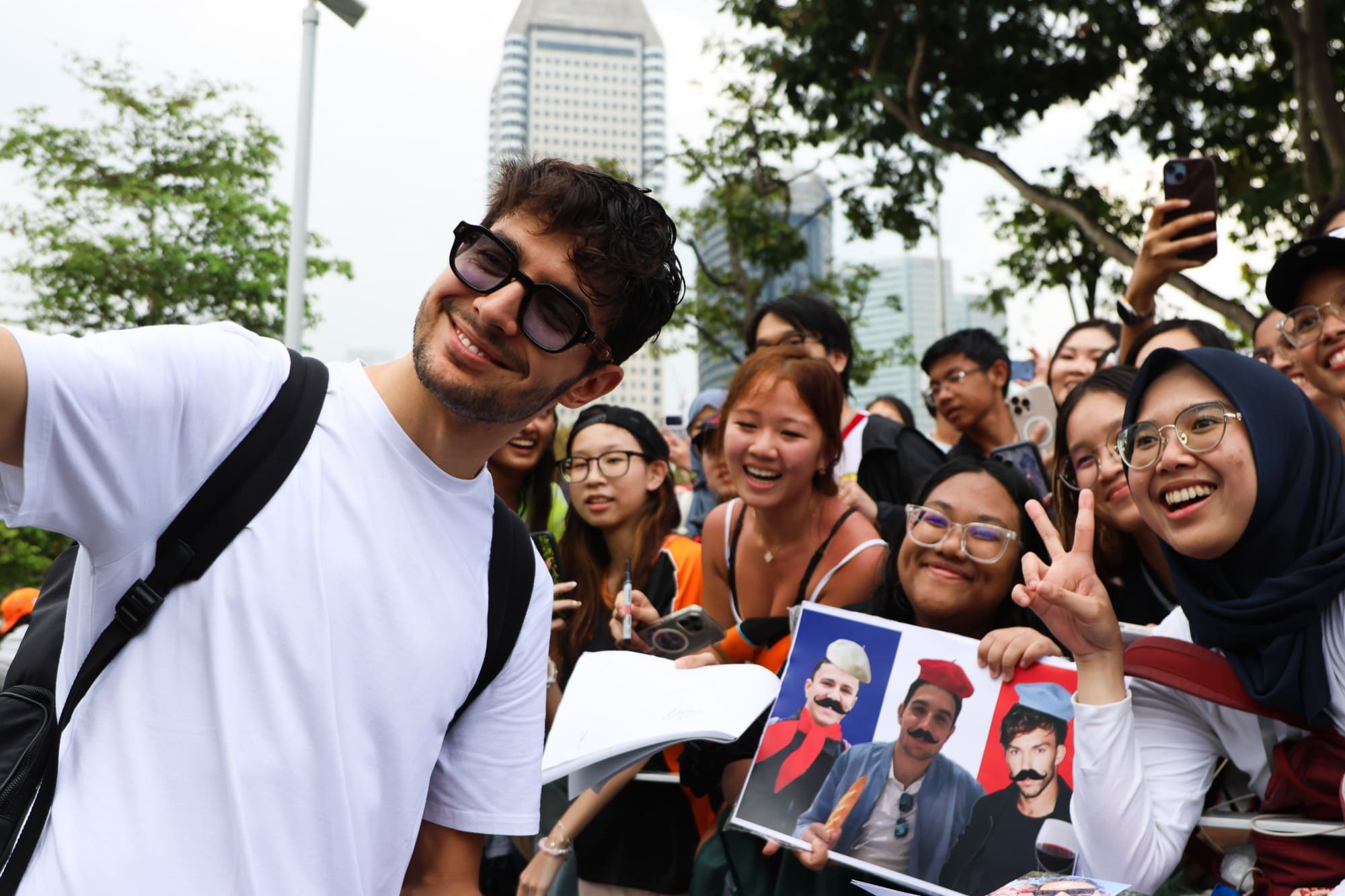
Esteban Ocon takes a selfie with fans at the 2025 Singapore Grand Prix. Photo: Wan Mikhail Roslan/ZUMA Press
Tips for your first race
- Ticket from work? Check if it’s hospitality. Paddock Club is a VIP area above the team garages, usually with food and drinks. It doesn’t get you into the paddock, where the teams work.
- Arrive early. Security queues are long.
- Plan your way home. Everyone leaves at once. Or stay for the concerts and let the crowds clear.
- Bring earplugs. The cars are still loud, and some support races are louder. A must for kids.
- Wear comfy shoes. You’ll walk a lot.
- Dress for the weather. Sunscreen and a hat for heat. A poncho for rain. Umbrellas block views and are banned at some tracks.
- Bring a power bank. Your phone won’t last the day.
- Check the bag rules. Some tracks only allow small or clear bags.
Our circuit guides cover maps, grandstands, transport and what to bring.
The 2026 rules, explained simply
You don’t need this to enjoy your first race. But 2026 brought big changes, so you’ll hear about them. Here’s the short version.
The cars are smaller and lighter, with skinnier tyres.
The engines are half electric. About half the power now comes from a battery. Like your phone, it runs flat if you overuse it. So drivers charge it and spend it all lap long.
The wings move. They flatten on the straights for speed. They tilt back up in corners for grip.
Overtake Mode helps drivers pass. Get within one second of the car ahead at the last corner, and you get extra battery power for the next lap. Watch the long straights.
Boost is a button for using saved battery power, anywhere on the lap. Think video game boost.
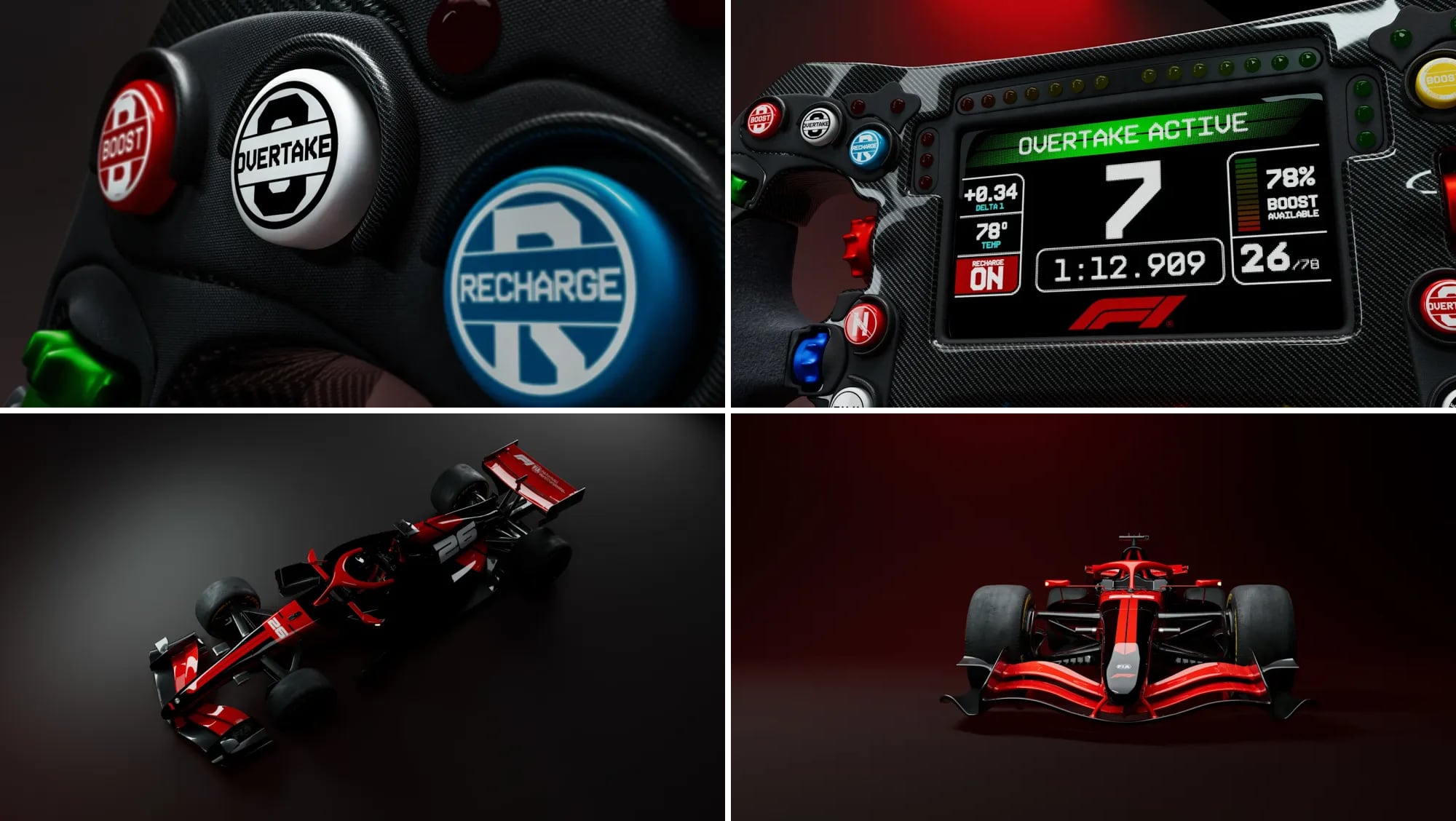
The new steering wheel buttons and screen, and the 2026 car, in F1’s illustrations. Images: Formula 1
Looks weird, but it’s normal: sometimes a car slows near the end of a straight, even at full throttle. It’s charging its battery. That’s called super clipping.
Want more? We asked whether F1 has gone too far with the tech.
The words you’ll hear
- Pole position: starting first.
- P1, P2, P3: first, second, third place.
- Box, box: come into the pits.
- Undercut: pit before a rival, then use your fresh tyres to jump ahead.
- Overcut: the opposite. Stay out longer and hope it pays off.
- Stint: the laps on one set of tyres.
- Deg: how fast tyres wear out.
- Dirty air: bumpy air behind a car. It makes following closely hard.
- Slipstream (tow): sitting right behind a car on a straight to go faster.
- Lift and coast: easing off early before a corner to save energy.
- Out lap, in lap: the lap out of the pits, and the lap into them.
- Parc fermé: French for “closed park”. After qualifying, teams can barely touch their cars.
- DNF: Did Not Finish.
- Team orders: a team telling one driver to let the other past.
- Stewards: the referees.
Fun facts to impress whoever you’re with
- Drivers sweat off up to 3 kg in a race. Mostly at hot races like Singapore.
- Their necks hold up about 30 kg in corners. Forces of up to 5G make the head and helmet five times heavier.
- The brakes hit over 1,000°C. At night races, you can see them glow.
- Their hearts race too. Often above 170 beats a minute, for the whole race.
- The halo can hold about 12 tonnes. That’s the bar above the driver’s head. It’s roughly a double-decker bus.
- In theory, an F1 car could drive on a ceiling. At speed, the air pushes it down harder than its own weight.
- “Box” comes from German. A pit stop is a “Boxenstopp”.
- The champagne spray didn’t start in F1. Dan Gurney began it at Le Mans in 1967.
- Monaco’s race is older than F1. It started in 1929. F1 began in 1950.
- Alonso raced in F1 before this year’s champion was born. He debuted in 2001. Antonelli was born in 2006.
Most of all, enjoy it. Plenty of people go to one race and get hooked. If that’s you, here are the cheapest F1 races to go to in 2027.